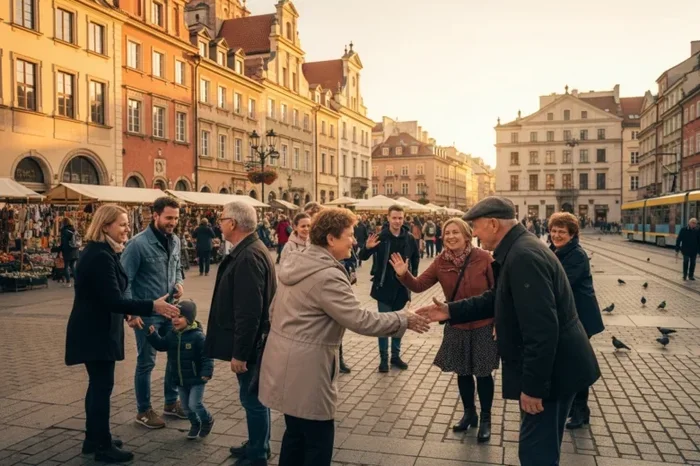

Learning how to say hello in Polish is your first step toward confident conversations with native speakers. This guide covers formal greetings, casual phrases, pronunciation tips, and cultural etiquette so you can greet anyone with confidence. Master these simple Polish greetings and start connecting with Polish speakers today.
Key Takeaways
- Cześć is the most common greeting: Use this casual “hello” with friends and people your age in everyday situations.
- Dzień dobry is the formal standard: This polite greeting works in professional settings, with strangers, and during daytime hours.
- Pronunciation matters: Polish has unique sounds that change meaning, so learning correct pronunciation is essential for being understood.
- Time-based greetings are natural: Polish speakers use different greetings depending on the time of day, just like in English.
- Cultural context shapes your greeting: Understanding when to be formal versus casual helps you avoid awkward moments in Polish conversations.
- Texting has its own greetings: Polish people use abbreviations in online chats, similar to English text shorthand.
📑 Table of Contents
- How to Say Hello in Polish and Sound Like a Native Speaker
- Basic Polish Greetings Every Beginner Should Know
- How to Say Hello in Polish: Formal vs. Informal Greetings
- Polish Greetings Based on Time of Day
- Polish Greeting Etiquette and Cultural Tips
- Polish Greetings in Texts and Online Chats
- How to Continue the Conversation After Greeting
- Common Mistakes When Greeting in Polish
- Conclusion
How to Say Hello in Polish and Sound Like a Native Speaker
Planning a trip to Poland, meeting Polish friends, or simply curious about the language? Knowing how to say hello in Polish is the most useful phrase you can learn. It opens doors to real conversations and shows respect for the culture. Whether you need a formal greeting for a business meeting or a casual hi for a friend, this guide has you covered.
Polish is spoken by over 45 million people worldwide. The language has a rich history and a unique sound that can feel tricky at first. But the good news is that Polish greetings are simple to learn. You do not need to master the entire language just to say a friendly hello. A few key phrases will go a long way in making a great first impression.
In this guide, you will learn formal and informal greetings, how to pick the right phrase for the situation, and tips for sounding natural. We will also cover pronunciation, cultural etiquette, and common mistakes to avoid. By the end, you will feel ready to greet Polish speakers with confidence.
Basic Polish Greetings Every Beginner Should Know
Starting with the essentials is the smartest way to build your Polish vocabulary. These greetings work in almost any situation. Let us look at the most important ones.
Cześć — The Go-To Casual Hello
Cześć (pronounced roughly like “cheshch”) is the most popular informal greeting in Polish. It means “hi” or “hello” and works among friends, peers, and people you already know. Think of it as the Polish version of saying “hey” in English.
You will hear cześć everywhere in Poland. At cafés, at parties, in group chats, and on the street. It is relaxed, friendly, and universally understood. If you only learn one Polish greeting, make it this one.
Here is how to use it:
- Meeting a friend on the street: Cześć! Jak leci? (Hi! How’s it going?)
- Joining a group chat: Cześć wszystkim! (Hi everyone!)
- Answering a phone call from a buddy: Cześć! (Hey!)
Dzień Dobry — Your Polite Daytime Greeting
Dzień dobry (pronounced “jen DOH-bri”) means “good day” and is the standard formal greeting in Polish. Use it during the daytime with strangers, coworkers, teachers, or anyone you want to show respect to. It is the safest choice when you are unsure whether to be formal or casual.
Most Polish people appreciate it when visitors make the effort to greet them properly. Saying dzień dobry shows that you care about the language and the culture. It immediately sets a positive tone for any interaction.
Hej — The Easy One-Syllable Hi
If you want something even simpler than cześć, try hej (pronounced like “hey”). It is borrowed from English and widely used in casual settings. Young Polish speakers love it. It works in person and online. Just keep in mind that hej is strictly informal, so skip it in formal situations.
How to Say Hello in Polish: Formal vs. Informal Greetings
Choosing between formal and informal greetings is an important part of Polish conversation. Polish culture values politeness, and using the wrong level of formality can feel awkward. Here is a simple breakdown to help you decide.
When to Use Formal Greetings
Formal greetings are your best friend in these situations:
- Meeting someone for the first time
- Speaking with older people or authority figures
- Workplace and professional settings
- Government offices and official appointments
- Entering a shop or restaurant during the day
The key formal greetings in Polish include:
- Dzień dobry — Good day (daytime)
- Dobry wieczór — Good evening
- Dobranoc — Good night (when parting at night)
Always pair dzień dobry with a handshake when meeting someone formally. Eye contact matters too. Polish people respect direct but polite body language.
When to Use Informal Greetings
Switch to casual greetings when:
- You are with friends or classmates
- Someone invites you to use “ty” (the informal “you”)
- You are in a relaxed social setting
- You are texting or chatting online
Popular informal options include cześć, hej, and siema (a very casual “hey” among close buddies). The key is matching your greeting to the relationship you have with the person.
| Situation | Recommended Greeting | Formality Level |
|---|---|---|
| Meeting a stranger | Dzień dobry | Formal |
| Talking to a coworker | Dzień dobry / Cześć | Semi-formal |
| Greeting a friend | Cześć / Hej | Informal |
| Online chatting | Cześć / Hej / Siema | Informal |
| Business meeting | Dzień dobry | Formal |
Polish Greetings Based on Time of Day
Just like in English, Polish greetings change depending on the time. Native speakers naturally adjust their hello based on the hour. Learning these time-specific phrases makes your Polish language sound more natural.
Morning, Afternoon, and Evening Greetings
- Dzień dobry — Use from early morning until about 6 PM. This is your daytime workhorse. It literally means “good day” and fits almost any daytime scenario.
- Dobry wieczór — Switch to “good evening” after sunset or during evening events. Pronounced “DOH-bri VEH-cheh-for.”
- Dobranoc — This means “good night” and is used when parting late at night or going to sleep. It is not used as a greeting when you arrive somewhere.
Quick Tip: When in Doubt, Say Dzień Dobry
If you are not sure what time-based greeting to use, dzień dobry works safely from morning until early evening. Polish people will not judge you for using it even a little after sunset. It is the most universally accepted greeting in the language.
Polish Greeting Etiquette and Cultural Tips
Knowing the right words is only part of the picture. Polish greeting etiquette includes body language, tone, and social norms that affect how your hello lands. Here are some insider tips.
Handshakes and Physical Greetings
In formal settings, a firm handshake with good eye contact is standard. Wait for the other person to offer a hug or cheek kiss before going physical. Among close friends, Polish people often greet each other with three kisses on the cheeks (one on the cheek, then alternating), but this is reserved for people they know well.
Here is a quick guide:
- Strangers and formal: Handshake and “dzień dobry”
- Acquaintances: Handshake or light nod with “cześć”
- Close friends (same gender): Cheek kisses or hugs
- Close friends (mixed gender): Cheek kisses or handshake
Tone and Sincerity Matter
Polish people value sincerity in greetings. Say dzień dobry with a warm smile and clear voice. Rushing through a greeting or mumbling it does not make a good impression. Take a breath, look the person in the eye, and deliver it with care.
Also, avoid starting a conversation with something heavy or negative right after your greeting. Polish culture appreciates a warm, positive start to any exchange. A simple Cześć, miło Cię widzieć! (Hi, nice to see you!) goes a long way.
Polish Greetings in Texts and Online Chats
Today, many Polish conversations happen online. Texting and social media have their own greeting styles. Polish internet users keep things short and playful, much like English speakers do. If you are curious about how English speakers abbreviate their texts, you might want to check out what “Wtw” means in text or learn the meaning of “Ts” in texting — these kinds of abbreviations are just as common in Polish online chats.
Popular Online Polish Greetings
- Cześć — Still the top pick for online hellos. Everyone uses it.
- Hej — Quick, easy, and perfect for group chats.
- Siema — Ultra-casual. Use it only with very close friends. Think of it as the Polish “yo.”
- Hejka — A softer, friendlier version of “hej.” Common among younger speakers.
- Cześćku — An extra-cute diminutive of “cześć.” You will see it in teen chats.
In group chats, Polish people often greet everyone at once. Try Cześć wszystkim! (Hi everyone!) or Hej, co słychać? (Hey, what’s up?) to join the conversation naturally.
How to Continue the Conversation After Greeting
Saying hello is just the opening line. To keep the Polish greeting flowing, you need a few follow-up phrases. These help you move past the basics and into real Polish language practice.
Essential Follow-Up Phrases
- Jak leci? — How’s it going? (casual)
- Jak się masz? — How are you? (slightly more formal)
- Co słychać? — What’s new? (casual and friendly)
- Wszystko dobrze? — Is everything okay? (caring and warm)
- Miło Cię widzieć! — Nice to see you! (great for any occasion)
Pairing your hello with one of these questions shows that you are genuinely interested in the other person. Polish people love meaningful conversations, and these phrases help you build rapport quickly.
Example Dialogues
Casual greeting between friends:
Cześć! Jak leci?
Wszystko super! A u ciebie?
Też dobrze, dzięki!
Formal greeting in a shop:
Dzień dobry. Poproszę dwa chleby.
Dzień dobry. Proszę bardzo.
Meeting someone new at a networking event:
Dzień dobry. Nazywam się Anna. Miło Cię poznać.
Dzień dobry, Anna. Miło mi Cię poznać. Jestem Tom.
Common Mistakes When Greeting in Polish
Even with the best intentions, learners make some predictable mistakes. Avoiding these will help your how to say hello in Polish efforts sound much more natural.
Mistake 1: Using Cześć in Formal Situations
Cześć is casual. Using it with a professor, a boss, or a stranger can come across as disrespectful. When in doubt, default to dzień dobry. It never hurts to be polite.
Mistake 2: Mispronouncing the Letters
Polish has sounds that do not exist in English. For example, the letter ą sounds like “own” and ł sounds like “w.” Saying dzień dobry with wrong vowel sounds can confuse listeners. Take time to listen to native speakers and mimic their pronunciation carefully.
Mistake 3: Forgetting to Smile
Words alone do not make a good greeting. Polish people notice your facial expression and body language. A warm smile makes even a simple cześć feel friendly and welcoming.
Mistake 4: Greeting at the Wrong Time
Using dzień dobry late at night sounds a bit odd. After evening, switch to dobry wieczór. Being aware of the time shows that you understand Polish customs and care about doing things right.
Expert Insight: Practice Daily
Language experts agree that daily practice is the fastest way to learn greetings naturally. Try saying your Polish hello out loud every morning. Record yourself and compare it to a native speaker online. Repetition builds muscle memory and boosts your confidence quickly.
Conclusion
Learning how to say hello in Polish is a simple but powerful skill. From the casual cześć to the polished dzień dobry, you now have the tools to greet anyone in any situation. You understand the difference between formal and informal greetings, the cultural etiquette that makes your words land well, and the follow-up phrases that keep conversations going.
Do not wait for the perfect moment. Start using these Polish greetings today. Text a Polish friend, greet a coworker, or practice with a language app. Every hello you say brings you one step closer to fluent and confident Polish language skills. Native speakers will appreciate your effort, and you will be amazed at how a simple greeting can open up meaningful connections.
The best way to master these phrases is repetition. Say them out loud, use them in real life, and listen to how Polish people greet each other. Before you know it, saying hello in Polish will feel completely natural.
Frequently Asked Questions
What is the most common way to say hello in Polish?
The most common greeting is cześć, which means “hi” or “hello.” It is casual and works in everyday situations with friends, peers, and people you already know. For formal settings, dzień dobry is the go-to choice.
How do you pronounce “dzień dobry” correctly?
Say it like “jen DOH-bri.” The “dź” in “dzień” sounds like a soft “jen,” and “dobry” has a clear “DOH” with a rolled “r” if possible. Listening to native speakers on YouTube or language apps is the best way to perfect your pronunciation.
Can I say “hi” in Polish instead of learning a special greeting?
Yes! Hej is the Polish equivalent of “hi” and is widely understood. It is informal, though, so use it with friends or people your age. In formal situations, stick with dzień dobry to show respect.
Is “siema” a proper Polish greeting?
Siema is a very casual greeting used among close friends. Think of it like saying “yo” in English. It is not appropriate for formal situations, but it is perfectly fine in relaxed social settings and group chats.
What is the difference between “cześć” and “hej” in Polish?
Both are casual greetings, but cześć is slightly more standard and warm, while hej is shorter and more playful. You can use either with friends. Cześć works in a wider range of casual situations, while hej feels very laid-back.
How do Polish people greet each other in emails?
In formal emails, Polish people start with Szanowny Panie/Szanowna Pani (Dear Mr./Ms.) followed by the surname. For semi-formal or friendly emails, Dzień dobry or Cześć works well. Always match your greeting to the tone of the message.



