
Learning how to say family in sign language is simpler than you think. This guide walks you through every family member sign in ASL, from parents to grandparents, with clear visual descriptions. Whether you want to communicate with deaf loved ones or expand your sign language skills, these easy steps will get you signing confidently in no time.
Key Takeaways
- Core Family Signs: Master the essential ASL signs for mother, father, brother, sister, and more.
- Simple Hand Movements: Most family signs use easy, memorable gestures anyone can learn.
- Facial Expressions Matter: Nonverbal cues add meaning and emotion to your signs.
- Practice Makes Perfect: Daily repetition and real conversations build fluency fast.
- Common Mistakes to Avoid: Watch out for confusing similar signs and neglecting context.
- Baby-Friendly Signs: Many family signs work great for teaching babies early communication.
📑 Table of Contents
- How to Say Family in Sign Language: A Complete Beginner Guide
- What Does Family Look Like in Sign Language?
- How to Sign Each Family Member in ASL
- Tips for Learning Family Signs Fast
- Common Mistakes When Signing Family Words
- Fun Ways to Practice Family Signs
- How Family Signs Connect to Deaf Culture
- Quick Tips for Remembering Family Signs
- Final Thoughts on Saying Family in Sign Language
How to Say Family in Sign Language: A Complete Beginner Guide
Have you ever wanted to sign the word family but didn’t know where to start? You are not alone. Thousands of people search for how to say family in sign language every single day. The good news? It is way easier than you might think. American Sign Language, or ASL, uses simple hand shapes and movements to represent words. And the word family is one of the most useful signs you will ever learn.
Whether you have a deaf friend, a baby you want to teach early communication, or you simply love learning new languages, this guide has you covered. We will break down every family member sign step by step. You will also learn tips, common mistakes, and fun ways to practice. By the end, you will be signing about your whole family like a pro.
Sign language is not just about hand movements. It involves your face, your body, and your expressions. Think of it as a full visual language. Once you understand that, everything clicks. So let us dive right in and learn how to sign family the easy way.
What Does Family Look Like in Sign Language?
The sign for family itself is beautiful and simple. It represents the idea of a group of people connected together. Here is exactly how to do it.
Step-by-Step: The Sign for Family
Follow these steps carefully:
- Extend both hands with your fingers spread apart.
- Tap your thumb against your chest twice.
- Move your hands outward slightly with each tap.
- Keep your facial expression warm and open.
The movement looks like you are gathering your loved ones close. That visual helps you remember the sign. Practice it slowly at first. Speed will come with time.
Why Family Signs Matter in ASL
Family is one of the first topics people learn in any language. In ASL, family signs are some of the earliest taught in classes and sign language dictionary resources. They connect us to our roots. They help us share who we are. And they open doors to deeper conversations with deaf friends and family members.
When you learn these signs, you are not just memorizing gestures. You are joining a rich visual culture. The deaf community values people who make the effort to communicate in their language. Your attempt alone shows respect and care.
How to Sign Each Family Member in ASL
Now let us get into the details. Each family member has its own unique sign. We will go through them one by one so you can build your vocabulary piece by piece.
Mother and Father Signs
These two signs are the foundation of all family signs. They are easy to remember because they use familiar letter shapes.
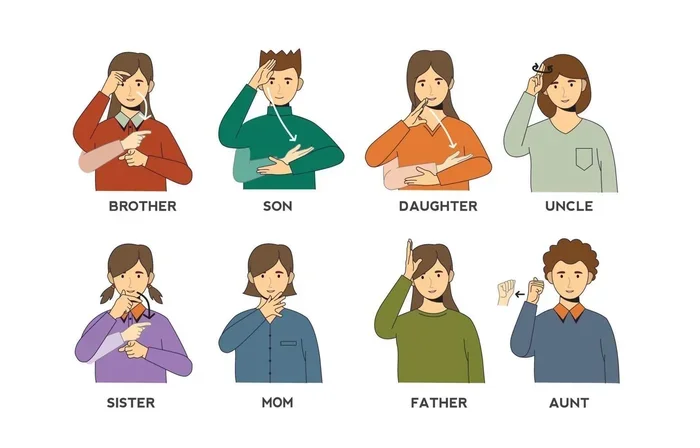
Mother: Touch your chin with the thumb of your open hand. Your other fingers should be extended and together. Tap your chin once. This sign uses the letter M shape near your face.
Father: Tap your forehead with your thumb. Keep your other fingers extended and together. This uses the letter F shape. The location on your forehead is what sets it apart from mother.
Try saying the word out loud while signing. This connection between spoken and signed words helps your brain remember faster.
Brother and Sister Signs
These signs are fun because they use similar movements with small differences.
Brother: Make an L shape with your dominant hand. Place it on your forehead. Then bring it down to tap your chest. Think of a boy wearing a cap walking down.
Sister: Start with both hands in an L shape at your forehead. Cross them over as they move down. This crossing motion represents two people coming together.
Both signs start at the forehead but end differently. Pay attention to those small details. They make all the difference in sign language accuracy.
Grandmother and Grandfather Signs
Grandparent signs build on the mother and father signs. They add a second location to show the generation above.
Grandmother: Start with the mother sign at your chin. Then move your hand up to your forehead. This two-location movement shows the elder generation.
Grandfather: Start with the father sign at your forehead. Then move your hand up a bit higher on your forehead. The slight upward motion shows respect for age.
These signs are especially sweet to use when talking about your elders. Try signing them when you share stories about your grandparents.
Baby and Child Signs
These signs are adorable and very practical, especially for parents and caregivers.
Baby: Cradle your arms as if holding an infant. Gently rock your arms back and forth. The motion itself tells the story.
Child: Point your index finger toward your ear. Then point it toward the person you are referring to. This directional quality is common in ASL.
Many parents use baby sign language long before their children can speak. Family signs like baby and mother are perfect starting points for this early communication method.
Tips for Learning Family Signs Fast
Learning signs takes practice, but smart strategies make it much easier. Here are proven tips to help you master family signs quickly.
Practice With Real Family Members
The best way to learn how to say family in sign language is to sign about your actual family. Sign about your mom while looking at her. Sign about your brother while standing next to him. This real-world practice locks the signs into your memory.
Get your whole family involved. Make it a game. Each person can learn their own sign and teach it to others. This creates bonding time and builds nonverbal communication skills at the same time.
Use Visual Aids and Videos
Sign language is visual by nature. Watching skilled signers is one of the best ways to learn. Look for ASL videos on platforms where native signers demonstrate signs clearly. Pay attention to hand shape, location, and movement.
Some people find it helpful to record themselves signing. Watching the playback reveals mistakes you might not notice in the moment. This self-review method accelerates progress dramatically.
Build a Daily Signing Habit
Consistency beats intensity. Five minutes of daily practice works better than one long session per week. Try signing your family members every morning. Make it part of your routine.
You can also label items around your house with sign language reminders. A sticky note near your phone might say “mother” with a small drawing of the sign. These small cues keep you engaged throughout the day.
Join a Signing Community
Learning alone is fine, but joining a community speeds things up. Look for local ASL meetups or online signing groups. Practicing with others gives you real conversation experience.
Many communities also host deaf events and workshops. These are fantastic opportunities to immerse yourself in deaf culture and practice your family signs in a supportive environment.
Common Mistakes When Signing Family Words
Everyone makes mistakes when learning a new language. The key is knowing what to watch out for. Here are the most common errors people make with family signs.
Confusing Similar Signs
Mother and father signs look similar because they both use the thumb. The key difference is location: chin for mother, forehead for father. Mixing these up is the number one beginner mistake.
Brother and sister signs also cause confusion. Remember that brother uses an L shape that moves straight down. Sister uses two L shapes that cross. Slow down and focus on the details.
Forgetting Facial Expressions
ASL is not just about your hands. Your face carries emotion and grammatical information. When signing about family, show warmth and joy. A flat expression can make your signs feel lifeless.
Smile when you sign about people you love. Raise your eyebrows slightly to show excitement. These small additions make your signing feel natural and engaging.
Skipping Practice Sessions
Signs fade from memory without regular use. If you skip practice for too long, you will need to relearn. Even one minute of review each day keeps your skills sharp.
Set a phone reminder if you need to. Treat your signing practice like brushing your teeth. It is a small habit with big long-term results.
Overcomplicating the Signs
Some beginners try to add unnecessary movements. Family signs are already simple and elegant. Resist the urge to add extra flourishes. Clean, clear signs are better than complex messy ones.
Focus on accuracy first. Speed and flow will develop naturally as your muscle memory builds. Trust the process.
Fun Ways to Practice Family Signs
Learning should be enjoyable. Here are creative ways to make practicing family signs fun for everyone.
Create a Family Sign Language Book
Draw or print pictures of each family sign. Arrange them in a small booklet. Review it together with your family every evening. This tactile activity works great for visual learners and young children.
Play Sign Language Charades
Take turns signing a family member while others guess. This game gets everyone moving and laughing. It also reinforces memory through active recall. You can make it competitive by keeping score.
For a tech twist, try texting your family signs using Wtw meaning in text conversations. Share sign language videos with distant relatives and keep the practice going across distances.
Share Your Learning Journey
Post about your sign language journey on social media. Create fun content like your funny family wifi names or share how your family is learning to sign together. This keeps you accountable and inspires others.
You could even create a family group chat where everyone practices signing. Pick some funny family group chat names to make it feel lighthearted and fun. Learning together strengthens bonds.
How Family Signs Connect to Deaf Culture
Learning family signs is about more than just vocabulary. It is a bridge to understanding deaf culture and the deaf community. When you sign about family, you participate in a visual tradition that spans generations.
Many deaf families pass down sign language from parent to child. For them, family signs are not just communication tools. They are cultural treasures. Understanding this deeper meaning enriches your learning experience.
Respect goes a long way. When you use family signs correctly, you honor the people who created and preserved this beautiful language. Approach every practice session with curiosity and humility.
Quick Tips for Remembering Family Signs
- Use mnemonics: Create mental images that link the sign to the word. Mother at the chin, father at the forehead.
- Sign while talking: Narrate your day using family signs. “This is my mother. This is my brother.”
- Teach someone else: Explaining signs to others reinforces your own knowledge.
- Watch and repeat: Mimic signs from videos exactly. Repetition builds muscle memory.
- Stay patient: Progress takes time. Celebrate small wins along the way.
Remember that every expert was once a beginner. Your journey to fluency starts with a single sign. Today, that sign might be family.
Final Thoughts on Saying Family in Sign Language
Learning how to say family in sign language opens up a whole new world of connection. You now know the signs for mother, father, brother, sister, grandmother, grandfather, baby, and child. You also understand the importance of facial expressions, consistent practice, and cultural respect.
Start with the signs that matter most to you. Sign about your own family first. Then expand outward as your confidence grows. Every new sign you learn strengthens your ability to communicate visually and connect with others.
Share what you have learned with your family and friends. Encourage them to join you. The journey becomes much more meaningful when you travel it together. And who knows, you might just inspire someone else to start their own sign language journey.
Keep practicing. Keep signing. Keep connecting. Your family signs are waiting to become second nature. Get out there and start signing today.
Frequently Asked Questions
Is sign language the same in every country?
No, sign languages vary by country just like spoken languages. American Sign Language is used primarily in the United States and parts of Canada. Other countries have their own sign languages, such as British Sign Language or Australian Sign Language. The family signs we covered here are specific to ASL.
Can babies learn family signs before they can speak?
Absolutely. Many parents use baby sign language to communicate with infants as young as six months old. Simple family signs like mother, father, and baby are excellent starting points. This early communication can reduce frustration and strengthen the parent-child bond.
How long does it take to learn family signs in ASL?
Most people can learn the basic family signs within a few days of regular practice. However, building fluency takes longer. Consistent daily practice, even just five to ten minutes, helps you retain the signs and use them naturally in conversation.
Do I need to be deaf to learn sign language?
Not at all. People of all hearing abilities learn sign language. It is a valuable skill for parents, educators, healthcare workers, and anyone who wants to communicate more inclusively. The deaf community welcomes learners at every level.
Are there apps that can help me practice family signs?
Yes, several apps are designed specifically for learning ASL. Look for apps that feature native signers demonstrating signs clearly. Some popular options include ASL dictionaries and interactive learning platforms. Combine app practice with real-life signing for the best results.
What should I do if I make mistakes while signing family words?
Mistakes are completely normal and part of the learning process. Even experienced signers refine their technique over time. The best approach is to practice with patient, supportive people who can gently correct you. Focus on progress, not perfection.
=== CONCLUSION ===
Learning how to say family in sign language is a rewarding journey that connects you to a vibrant visual language and community. From the simple chin tap for mother to the gentle rocking motion for baby, each sign carries meaning and emotion. You now have the tools, tips, and knowledge to start signing about your family with confidence. Practice daily, stay patient with yourself, and remember that every sign you learn brings you closer to meaningful communication. Your family is worth the effort. So go ahead, put your hands to work, and start signing about the people you love most.