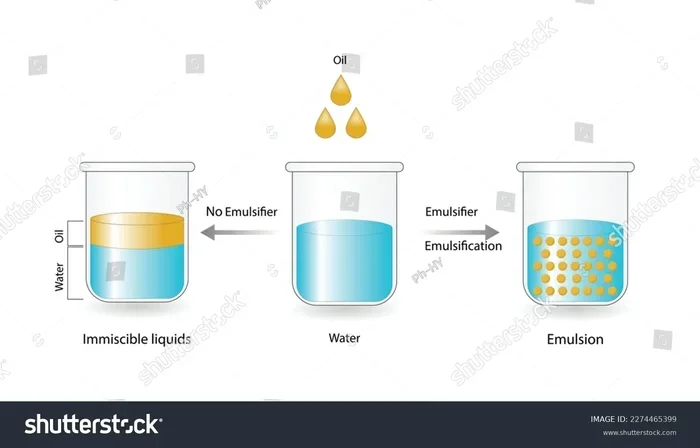

The emulsion meaning is simple: it is a mixture of two liquids that normally do not blend together. One liquid spreads tiny droplets through the other, creating a stable blend. You encounter emulsions daily in foods like mayonnaise, milk, and salad dressing, as well as in lotions, paints, and photographic films.
You shake a bottle of salad dressing and watch the oil and vinegar swirl together for a moment. Then, within minutes, they split apart again. That is because oil and water do not naturally mix. But what if you could force them to stay blended? That is exactly what an emulsion does.
The emulsion meaning is straightforward. An emulsion is a mixture of two or more liquids that would not normally combine. One liquid forms tiny droplets and disperses throughout the other liquid. The result is a smooth, uniform blend that looks like a single liquid. Emulsions are everywhere in your daily life, even if you do not realize it.
In this article, we will break down the emulsion definition in plain language. You will learn how emulsions work, where you find them, and why they matter. We will also explore the science, the different types, and practical tips for understanding this fascinating concept. Whether you are a student, a home cook, or just curious, this guide covers it all.
Key Takeaways
- Emulsion meaning: A mixture where one liquid is dispersed as tiny droplets inside another liquid that it would not normally mix with.
- Two main types exist: Oil-in-water and water-in-oil emulsions, each with distinct properties and uses.
- Emulsifiers are essential: Substances like lecithin, soap, and proteins help keep emulsions stable and prevent separation.
- You use emulsions every day: From food products like mayonnaise and milk to skincare creams and emulsion paints.
- Emulsions differ from solutions and suspensions: Understanding these differences helps you grasp why emulsions behave the way they do.
- Stability matters: Factors like temperature, agitation, and emulsifier type determine how long an emulsion lasts.
- Emulsion technology has broad applications: It plays a vital role in medicine, cosmetics, food science, and industrial manufacturing.
📑 Table of Contents
What Does Emulsion Mean?
The emulsion meaning comes from the Latin word “emulgere,” which means to milk out. This makes sense because milk itself is one of the most common emulsions you will ever encounter. At its core, an emulsion is a colloidal dispersion where liquid droplets are suspended in another liquid.
To understand this better, think about what happens when you pour oil into water. The oil floats on top. The two liquids separate quickly. This is because oil molecules are nonpolar, and water molecules are polar. They simply do not attract each other. But when you add energy — by shaking, stirring, or blending — you break one liquid into tiny droplets. Those droplets spread through the other liquid. If the mixture stays blended, you have created an emulsion.
The key word here is “stays blended.” A temporary mixture is not an emulsion. A true emulsion remains stable for a meaningful period. It resists separation. This stability is what sets emulsions apart from simple mixtures and suspensions.
Emulsion vs. Solution vs. Suspension
People often confuse emulsions with solutions and suspensions. Let us clear up the differences. A solution is when one substance dissolves completely in another. Salt dissolving in water is a perfect example. You cannot see the salt, and it does not settle out. A suspension is when solid particles are mixed into a liquid but eventually settle down. Mud in water is a suspension. The particles are too heavy to stay suspended forever.
An emulsion sits right in the middle. It involves liquid droplets suspended in another liquid. The droplets are larger than molecules in a solution but small enough to stay dispersed for a while. The size of these droplets typically ranges from 0.1 to 100 micrometers. This range is what gives emulsions their unique cloudy or opaque appearance.
How Emulsions Work in Everyday Life
You interact with emulsions more often than you might think. They are not just a chemistry concept. They are practical, useful, and found in countless products you use every single day.
Food Emulsions
Your kitchen is full of emulsions. Mayonnaise is one of the most classic examples. It combines oil and vinegar (which contains water) into a thick, creamy sauce. The secret is egg yolk, which acts as a natural emulsifying agent. Egg yolk contains lecithin, a molecule that has both water-loving and oil-loving parts. This dual nature helps bridge the gap between oil and water.
Milk is another perfect example. Milk is a water-in-fat emulsion where tiny fat globules are dispersed in water. Cream is the fat-rich layer that rises to the top when milk sits. Homogenization is the process that breaks fat globules into smaller droplets so they stay suspended evenly. This is why store-bought milk has a uniform consistency.
Other common food emulsions include:
- Salad dressings — especially bottled ones that use stabilizers
- Butter — which is a water-in-oil emulsion
- Ice cream — where fat droplets are dispersed in a sugar-water solution
- Hollandaise sauce — an egg yolk and butter emulsion
- Nut butters — where oils are spread through protein and fiber
Skincare and Cosmetics
The emulsion meaning extends well beyond the kitchen. Your skincare routine likely involves emulsions every morning and night. Emulsion creams and lotions combine water and oil into a smooth, spreadable product. These formulations rely on emulsifiers like cetearyl alcohol, polysorbates, and stearic acid to keep the blend stable.
Without emulsifiers, your moisturizer would separate into a greasy oil layer and a watery layer. The product would be useless. Emulsifiers make sure every pump or squeeze delivers a consistent blend of water, oil, and active ingredients. This is why your skin feels hydrated and smooth after application.
Photography and Film
The word “emulsion” has a special meaning in photography. A photographic emulsion is a thin layer of silver halide crystals suspended in gelatin. This light-sensitive coating is applied to film and photographic paper. When light hits the emulsion, it creates a latent image that can be developed into a photograph.
Even though digital photography has taken over, the term “emulsion” still holds a special place in the world of analog photography. Film photographers still refer to their light-sensitive coating as the emulsion layer. The emulsion meaning in this context is slightly different from the chemistry definition, but the core idea remains the same: tiny particles dispersed throughout a medium.
Emulsion Paints and Coatings
If you have ever painted a wall, you have used an emulsion paint. Also known as latex paint, emulsion paint uses water as the primary carrier instead of solvent. Tiny polymer particles are dispersed in water, and as the paint dries, the water evaporates and the particles fuse together into a durable, flexible film.
Emulsion paints are popular because they are low in volatile organic compounds (VOCs). They dry faster than oil-based paints and have a milder odor. They are also easier to clean up with just soap and water. The emulsion technology behind these paints has revolutionized the paint industry.
The Science Behind Emulsions
Now let us dive into the science. Understanding why emulsions form and how they stay stable will give you a deeper appreciation for this phenomenon.
Why Do Two Liquids Refuse to Mix?
The reason oil and water do not mix comes down to molecular polarity. Water molecules are polar, meaning they have a positive end and a negative end. This polarity allows water molecules to form strong bonds with each other. Oil molecules are nonpolar, meaning they have no charge separation. Oil molecules prefer to bond with other oil molecules, not with water.
When you pour oil into water, the water molecules push the oil away. The oil clusters together and floats to the surface. This is the natural state of affairs. Creating an emulsion requires you to overcome this natural repulsion. You need energy and a helper.
The Role of Emulsifiers
An emulsifier is a substance that helps two immiscible liquids stay mixed. Emulsifier molecules have a dual structure. One end is hydrophilic, meaning it loves water. The other end is hydrophobic, meaning it fears water and loves oil. This dual nature allows the emulsifier to sit at the boundary between oil and water droplets.
Common emulsifiers include:
- Lecithin — found in egg yolks and soybeans
- Sodium stearoyl lactylate — used in bread and baked goods
- Polysorbates — found in ice cream and cosmetics
- Casein — a protein in milk that stabilizes dairy emulsions
- Soap and detergents — classic emulsifiers used in cleaning
- Gum arabic — a natural stabilizer used in beverages
Without an emulsifier, even a vigorously shaken mixture will separate quickly. The emulsifier coats the surface of each droplet and prevents them from merging back together. This process is called steric stabilization, and it is the secret behind every long-lasting emulsion.
Factors That Affect Emulsion Stability
Not all emulsions last forever. Several factors determine how stable an emulsion remains over time:
- Droplet size — Smaller droplets create more stable emulsions because they resist merging more effectively.
- Temperature — Heat can break emulsions by changing the viscosity of the liquids and weakening the emulsifier film.
- pH levels — Some emulsifiers work best within specific pH ranges. Changing the acidity can cause the emulsion to break.
- Electrolyte concentration — Salt and other ions can destabilize certain emulsions by disrupting the electrical charges around droplets.
- Agitation — The amount of mixing energy used during formation affects droplet size and distribution.
- Emulsifier concentration — Too little emulsifier means not enough coverage around droplets, leading to faster separation.
Understanding these factors is essential for anyone working with emulsions in food science, cosmetics, or industrial applications. Emulsion stability is a key goal in formulation science, and researchers spend years perfecting the balance of ingredients to create long-lasting blends.
Types of Emulsions You Should Know
Emulsions come in different forms. The two primary types are oil-in-water and water-in-oil. Each type has unique properties and applications.
Oil-in-Water Emulsions
In an oil-in-water emulsion, tiny oil droplets are dispersed throughout a continuous water phase. This is the most common type of emulsion you will encounter. Milk, mayonnaise, and most skincare lotions are oil-in-water emulsions.
The characteristics of oil-in-water emulsions include:
- A lighter, less greasy feel
- Easy washing with water
- A more fluid, pourable consistency
- Wider use in food and personal care products
Water-in-Oil Emulsions
In a water-in-oil emulsion, tiny water droplets are dispersed in a continuous oil phase. Butter and margarine are classic examples. These emulsions feel richer and more moisturizing on the skin, which is why many heavy creams and cold creams use this formulation.
Water-in-oil emulsions are harder to wash off with water alone. They tend to feel more greasy and occlusive. However, they provide excellent moisture retention, which makes them valuable in certain skincare and pharmaceutical applications.
Multiple Emulsions
There is also a more complex category called multiple emulsions. These include water-in-oil-in-water (W/O/W) and oil-in-water-in-oil (O/W/O) systems. Multiple emulsions are used in advanced drug delivery systems, where they help control the release of active ingredients over time. They are also used in flavor encapsulation for food products.
Common Emulsions in Daily Products
The emulsion meaning becomes even clearer when you see how widely these mixtures are used. Below is a quick look at everyday products that rely on emulsion technology.
| Product Category | Example | Type of Emulsion | Key Emulsifier |
|---|---|---|---|
| Food | Mayonnaise | Oil-in-water | Lecithin from egg yolk |
| Dairy | Milk | Water-in-fat | Casein protein |
| Skincare | Moisturizing lotion | Oil-in-water | Cetearyl alcohol |
| Paint | Latex wall paint | Polymer-in-water | Surfactants |
| Photography | Film coating | Silver halide in gelatin | Gelatin binder |
| Medicine | Oral emulsion | Oil-in-water | Polysorbate 80 |
| Cleaning | Dish soap | Oil-in-water | Sodium lauryl sulfate |
This table shows just how versatile emulsions are. They span industries from food to medicine, from art to cleaning. The emulsion formulation process is tailored to each application, with specific emulsifiers chosen for their compatibility and performance.
How to Create a Stable Emulsion
Creating an emulsion at home is surprisingly simple. You do not need a laboratory. You need the right ingredients and a bit of energy. Here is a step-by-step guide to making a basic oil-in-water emulsion.
Step 1: Gather your ingredients. You need oil, water, and an emulsifier. For a kitchen experiment, use vegetable oil, water, and an egg yolk. For a cosmetic version, use a light oil, distilled water, and an emulsifying wax.
Step 2: Combine the water and emulsifier. Start by mixing the water phase with your emulsifier. This ensures the emulsifier is evenly distributed before it encounters the oil.
Step 3: Add the oil slowly. Drizzle the oil into the water phase while stirring constantly. Adding the oil too quickly will overwhelm the emulsifier and cause separation.
Step 4: Blend vigorously. Use a whisk, blender, or immersion mixer to provide enough energy to break the oil into tiny droplets. The smaller the droplets, the more stable the emulsion will be.
Step 5: Test the emulsion. Let the mixture sit for several hours. If it remains smooth and uniform, you have successfully created an emulsion. If it separates, try adding more emulsifier or blending for a longer time.
Quick Tip: A high-shear mixer or blender works much better than a simple whisk for creating stable emulsions. The mechanical force breaks oil into finer droplets, which results in a smoother and longer-lasting blend.
Common Mistakes When Making Emulsions
Even with the best intentions, emulsions can fail. Here are some common mistakes to avoid:
- Adding oil too fast — This overwhelms the emulsifier before it can coat the new droplets.
- Using too little emulsifier — Not enough emulsifier means incomplete coverage and rapid separation.
- Skipping the emulsifier entirely — Shaking oil and water alone creates a temporary mixture, not a true emulsion.
- Using the wrong type of emulsifier — Not all emulsifiers work with all oil-water combinations. Match the emulsifier to your specific formulation.
- Ignoring temperature — Some emulsions form better at specific temperatures. Cold ingredients can slow the process and create uneven droplets.
Avoiding these mistakes will save you frustration and help you create emulsions that last. Whether you are making mayonnaise in your kitchen or formulating a commercial cream, the principles remain the same.
Why Emulsions Matter in Science and Industry
The emulsion meaning goes far beyond kitchen chemistry. Emulsions play a critical role in medicine, agriculture, and industrial manufacturing. Understanding emulsion science helps professionals develop better products and more efficient processes.
In pharmaceuticals, emulsions are used to deliver drugs more effectively. Liquid emulsions allow for easier ingestion of medicines, especially for children and elderly patients. Emulsion-based drug delivery systems can target specific areas of the body and release active ingredients slowly over time. This improves treatment outcomes and reduces side effects.
In agriculture, emulsion concentrates are used to deliver pesticides and herbicides evenly across crops. These formulations ensure that the active ingredient spreads uniformly and adheres to plant surfaces. This leads to better pest control and less waste.
In industrial applications, emulsions are used in metalworking fluids, textile treatments, and adhesive formulations. Emulsion polymerization is a process where polymer particles are formed within an emulsion medium. This technique produces latexes used in paints, adhesives, and synthetic rubber. The ability to control particle size and distribution through emulsion technology has opened up countless possibilities in materials science.
The emulsion technology field continues to evolve. Researchers are developing new emulsifiers, smarter delivery systems, and more sustainable emulsion formulations. As industries seek greener and more efficient processes, emulsions will remain at the center of innovation.
Emulsion Meaning in Different Contexts
One of the interesting things about the word “emulsion” is that it carries slightly different meanings depending on the context. In chemistry, it refers to a colloidal dispersion of two immiscible liquids. In photography, it refers to the light-sensitive coating on film. In dermatology, an emulsion simply means a lightweight moisturizer that absorbs quickly into the skin.
Despite these contextual differences, the underlying principle is the same. An emulsion is a carefully balanced mixture where one substance is finely dispersed within another. The emulsion definition always revolves around this core concept of dispersed droplets and continuous phases.
Understanding these different contexts helps you appreciate the versatility of emulsions. Whether you are a photographer developing film, a formulator creating a new skincare product, or a chef perfecting a sauce, emulsions are an essential part of your toolkit.
Final Thoughts
The emulsion meaning is simpler than it might seem at first glance. An emulsion is just a stable blend of two liquids that normally would not mix. With the help of emulsifiers and mechanical energy, these mixtures come to life in products we use every day.
From the mayonnaise on your sandwich to the lotion on your skin, from the paint on your walls to the film in your camera, emulsions are quietly at work. They make our food tastier, our skin healthier, and our lives more convenient. The next time you shake a bottle of salad dressing or smooth on a cream, you will know exactly what is happening at the molecular level.
Emulsions bridge the gap between science and everyday life. They show us that even the most basic principles of chemistry can have a profound impact on the world around us. So the next time someone asks you about the emulsion definition, you can explain it with confidence and clarity.
Understanding emulsions opens a door to a deeper appreciation of the products and processes that shape our daily routines. It is a small but powerful piece of knowledge that connects you to the science hidden in plain sight. Embrace it, explore it, and share it with others.
Frequently Asked Questions
What is the simplest definition of an emulsion?
An emulsion is a mixture of two liquids that do not normally blend together, where one liquid is dispersed as tiny droplets throughout the other. Think of it like oil and vinegar that have been forced to stay mixed with the help of an emulsifier. Mayonnaise and milk are perfect everyday examples.
What is the difference between an emulsion and a solution?
A solution is a homogeneous mixture where one substance dissolves completely in another, like salt in water. An emulsion involves liquid droplets suspended in another liquid, and the mixture is not truly homogeneous. Emulsions are cloudy or opaque, while solutions are clear and transparent.
What are common emulsifiers found in food?
Common food emulsifiers include lecithin from egg yolks and soybeans, mono- and diglycerides used in baked goods, polysorbates found in ice cream, and casein protein from milk. These substances help oil and water stay blended in products like mayonnaise, salad dressings, and processed foods.
Can an emulsion break or separate over time?
Yes, emulsions can break or separate, especially if they lack a proper emulsifier or are exposed to temperature changes. When an emulsion breaks, the two liquids return to their separate layers. This is why some bottled salad dressings need to be shaken before use.
Is milk an emulsion?
Yes, milk is a natural emulsion. It is a water-in-fat emulsion where tiny fat globules are dispersed throughout a water-based solution. The proteins and fats in milk act as natural emulsifiers, keeping the fat globules evenly suspended.
How is emulsion technology used in medicine?
In medicine, emulsions are used to deliver drugs in liquid form for easier ingestion and better absorption. Emulsion-based formulations can target specific areas of the body and release medication slowly over time. This technology improves the effectiveness of treatments and makes medicines more accessible to patients who have difficulty swallowing pills.
=== CONCLUSION ===
The emulsion meaning is a fascinating topic that touches every aspect of our lives. From the food we eat to the products we use on our skin, emulsions are everywhere. They represent a beautiful intersection of science and practicality, where chemistry meets everyday convenience.
Now that you understand what an emulsion is, how it works, and where you find it, you can look at the world with fresh eyes. Every bottle of salad dressing, every jar of butter, every tube of moisturizer, and every can of wall paint tells a story of emulsion science. The principles are simple, the applications are vast, and the impact is real.
Take what you have learned here and apply it. Try making mayonnaise from scratch. Read the ingredient labels on your skincare products. Appreciate the role that emulsifiers play in keeping your favorite products consistent and effective. The emulsion definition is more than just a chemistry term. It is a window into how the world blends, balances, and works together.



