
Learning how to say 1:30 in Spanish is simple once you know the two main phrases: “es la una y media” and “la una y treinta.” Spanish speakers use both forms daily, and understanding when to use each will boost your confidence. This guide breaks down the rules, offers real-life examples, and shares quick tips to help you master telling time in Spanish.
Key Takeaways
- Two Ways to Say It: You can say “es la una y media” or “la una y treinta” to express 1:30 in Spanish.
- Context Matters: Use “y media” in casual conversations and “y treinta” in more formal or precise settings.
- Spanish Time Rules Are Logical: Once you understand how the 12-hour clock works in Spanish, telling time becomes much easier.
- Common Mistakes Are Avoidable: Forgetting gender agreement or using the wrong article are the most frequent errors learners make.
- Practice Makes Perfect: Using real-life examples and daily practice will help you internalize how to say 1:30 and other times naturally.
📑 Table of Contents
What Does “1:30” Look Like in Spanish?
If you have ever wondered how to say 1:30 in Spanish, you are not alone. It is one of the most common time expressions beginners want to learn. The good news? It is straightforward and easy to remember.
In English, we say “one-thirty.” In Spanish, you have two natural options. You can say “es la una y media” or “la una y treinta.” Both are correct. Native speakers use them every day without thinking twice.
The phrase es la una y media literally means “it is one and a half.” The phrase la una y treinta means “one thirty.” Each has its place depending on the situation. Let us break them both down so you feel totally confident.
How to Say 1:30 in Spanish: The Two Main Ways
There are two standard ways to express 1:30 in Spanish. Let us look at each one closely.
Option 1: “Es la una y media”
This is the most common way to say 1:30 in casual conversations. It is short, natural, and everyone understands it.
Here is how it breaks down:
- Es = It is
- la una = one o’clock
- y media = and a half
Put it together, and you get “Es la una y media.” Simple, right? This is what you will hear most often in everyday Spanish. Friends, family, and coworkers all use this form.
Option 2: “La una y treinta”
This version is slightly more precise. Some people prefer it because it uses numbers instead of the word “media.”
Here is the breakdown:
- La una = one o’clock
- y treinta = and thirty
So “La una y treinta” means “one thirty.” This form sounds a bit more formal. You might hear it in business settings or when someone wants to be very exact about the time.
Both forms are perfectly correct. Use whichever feels most natural to you. Over time, you will naturally gravitate toward one.
Understanding the Spanish Time System
Telling time in Spanish follows a clear set of rules. Once you understand the basics, you can tell any time, not just 1:30.
The 12-Hour Clock in Spanish
Spanish uses a 12-hour clock just like English. However, there are a few key differences you should know.
- Morning times use “de la mañana.”
- Afternoon times use “de la tarde.”
- Night times use “de la noche.”
For example, 1:30 in the morning would be “es la una y media de la mañana.” 1:30 in the afternoon would be “es la una y media de la tarde.”
How to Say Other Half-Hour Times
The pattern for 1:30 works for all half-hour times. Here are a few examples:
- 2:30 = Son las dos y media
- 3:30 = Son las tres y media
- 4:30 = Son las cuatro y media
Notice how the verb changes from “es” to “son” when the hour is plural. This is one of the most important rules in Spanish time-telling.
Using “Media” vs. “Treinta”
Both “media” and “treinta” mean thirty. But they are used in slightly different ways.
- Media is used after “y” to mean “half past.” It is more casual and common.
- Treinta is the actual number thirty. It sounds more precise and formal.
For 1:30, both “y media” and “y treinta” work. But for other times, “media” only works with half-hours. You cannot say “y media” for 1:45, for example.
Common Mistakes When Saying 1:30 in Spanish
Even though saying 1:30 in Spanish is simple, learners still make a few common errors. Let us look at the top mistakes and how to avoid them.
Mistake 1: Using the Wrong Article
In Spanish, “la” and “las” are not interchangeable. For 1:30, you must say “la una” because “una” is singular. For 2:30, you say “las dos” because “dos” is plural.
Getting this wrong can make your Spanish sound off to native speakers. But it is an easy fix once you know the rule.
Mistake 2: Forgetting Gender Agreement
The word “media” is feminine. So it pairs with “la” and not “el.” Some learners accidentally say “es el una y media,” which is incorrect. Always use “es la una y media.”
Mistake 3: Mixing Up AM and PM
Spanish does not use AM and PM the same way English does. Instead, it uses “de la mañana,” “de la tarde,” and “de la noche.” Make sure you include the right time-of-day marker when needed.
Mistake 4: Overcomplicating Things
Some learners try to translate word-for-word from English. This often leads to awkward phrasing. Trust the natural Spanish patterns. They are logical and consistent once you practice them.
While you are learning how to say times in Spanish, you might also encounter confusing text abbreviations when chatting with friends. If you ever see WTW or TS in a text and are unsure what they mean, it helps to know that these are common text slang terms that have nothing to do with time-telling. Understanding text abbreviations is a separate skill from learning how to express time in another language.
Practical Examples and Conversations
The best way to learn how to say 1:30 in Spanish is to see it in action. Here are some real-life examples you can use right away.
Example 1: Making Plans
Imagine a friend asks you what time you want to meet. You could say:
“Quedemos a la una y media.” (Let us meet at 1:30.)
This is a natural, everyday sentence. Your Spanish-speaking friend will understand it immediately.
Example 2: Asking About the Time
If someone asks you what time it is, you can respond:
“Son las una y treinta.” (It is one thirty.)
Wait, that is not quite right. The correct form is “Es la una y treinta.” Remember, “una” is singular, so you use “es” not “son.”
Example 3: Setting an Alarm
You might tell someone:
“Pon la alarma para la una y media de la tarde.” (Set the alarm for 1:30 in the afternoon.)
This sentence includes the time of day, which makes it extra clear.
Example 4: A Quick Text Message
In a casual text, you might write:
“¿A qué hora quedamos? — A la una y media.” (What time are we meeting? — At 1:30.)
Short, sweet, and perfectly natural.
Quick Tips for Mastering Spanish Time
Here are some fast tips to help you get better at telling time in Spanish.
- Practice daily. Say the time out loud every morning. It only takes a few seconds.
- Use flashcards. Write different times on cards and quiz yourself.
- Watch Spanish shows. Pay attention to how characters mention the time.
- Set your phone to Spanish. This exposes you to time expressions all day long.
- Talk to native speakers. Real conversation is the fastest way to improve.
- Start with the half-hours. Times like 1:30, 2:30, and 3:30 are the easiest to master first.
Follow these tips consistently, and you will be telling time in Spanish before you know it.
Why Learning to Say 1:30 in Spanish Matters
Telling time is one of the first skills you need in any new language. Whether you are traveling, working, or chatting with friends, knowing how to say 1:30 in Spanish comes up constantly.
It is also a gateway skill. Once you know how to say 1:30, you can easily learn 1:31, 1:32, and beyond. The same patterns apply. You just swap out the numbers.
Plus, speaking another person’s language builds trust and connection. Even a simple phrase like “es la una y media” shows respect and effort. People appreciate it, and it opens doors in both personal and professional settings.
Learning how to say time in Spanish also helps you understand broader concepts like schedules, appointments, and daily routines. These are all essential parts of everyday communication.
Conclusion
So, how do you say 1:30 in Spanish? You now know two natural ways: “es la una y media” and “la una y treinta.” Both are correct, widely used, and easy to remember.
The key is practice. Use these phrases in real conversations. Make mistakes. Learn from them. Over time, telling time in Spanish will feel second nature.
Start today. Say 1:30 out loud a few times. Share what you have learned with a friend. Every small step counts. You are building a real skill, and that is something to be proud of.
Frequently Asked Questions
What is the most common way to say 1:30 in Spanish?
The most common way is “es la una y media.” It is short, natural, and used by native speakers in everyday conversations. Most learners start with this form because it is easy to remember and sounds completely natural.
Can I say “la una y treinta” instead of “es la una y media”?
Yes, absolutely. “La una y treinta” is also correct. It is a bit more precise and formal. Both forms are widely accepted, so use whichever one feels most comfortable for your situation.
Do I say “es” or “son” when telling time in Spanish?
Use “es” for one o’clock (la una) because it is singular. Use “son” for all other hours (las dos, las tres, etc.) because they are plural. This is one of the most important rules in Spanish time-telling.
How do I say 1:30 in the morning in Spanish?
You would say “es la una y media de la mañana.” Adding “de la mañana” specifies that it is in the morning. This pattern works for all times of day in Spanish.
Is “y media” the same as “y treinta” in Spanish?
Yes, both mean “thirty” or “half past.” However, “y media” is more common in casual speech, while “y treinta” sounds slightly more formal. Native speakers use both interchangeably in most situations.
What are some other useful Spanish time expressions to learn?
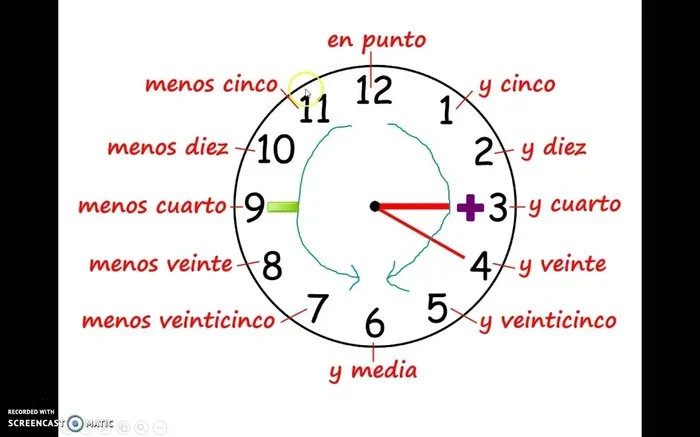
Some great ones to start with include “y cuarto” (quarter past), “y media” (half past), and “en punto” (sharp/on the dot). Learning these expressions will help you tell time in Spanish with confidence and ease.