
Learning how to say happy easter in greek opens the door to one of the world’s most vibrant and meaningful celebrations. From the classic Καλό Πάσχα to the powerful Christ is risen exchange, this guide covers every greeting you need. You’ll also discover Greek Easter traditions, pronunciation tips, and practical advice for using these phrases like a true native speaker.
Key Takeaways
- Καλό Πάσχα is the standard way to say happy easter in greek and works in almost any setting.
- Χριστός ἀνέστη (Christ is risen) is the traditional religious greeting used during Greek Orthodox Easter services.
- Greek Easter celebrations go far beyond greetings, featuring tsougrisma, Holy Week rituals, and feasting.
- Pronunciation matters—getting the Greek letters right shows respect and helps native speakers appreciate your effort.
- You can use these Easter wishes in texts, cards, face-to-face conversations, and social media posts.
- Avoid common mistakes like using incorrect Greek grammar or ignoring the cultural significance of religious greetings.
- Timing your Easter message correctly—especially during Holy Week—adds authenticity to your greetings.
📑 Table of Contents
- Why Saying Happy Easter in Greek Matters More Than You Think
- How to Say Happy Easter in Greek: The Most Common Greeting
- The Traditional Religious Greeting: “Christ Is Risen”
- Other Happy Easter Greetings in Greek
- Greek Easter Traditions That Will Blow Your Mind
- How to Use These Greetings in Everyday Life
- Common Mistakes When Saying Happy Easter in Greek
- Expert Insights: What Greek Natives Want You to Know
- Conclusion: Speak, Celebrate, and Connect
Why Saying Happy Easter in Greek Matters More Than You Think
Easter is huge in Greece. It is not just a holiday—it is the biggest and most meaningful celebration of the entire year. For Greek Orthodox Christians, Easter (or Pascha) carries deep spiritual weight. It marks the resurrection of Jesus Christ and brings families together for feasting, singing, and centuries-old rituals.
So when you learn how to say happy easter in greek, you are not just learning a phrase. You are stepping into a rich cultural tradition. You are telling someone that you respect their faith, their customs, and their language. That small effort can make a big difference. It can spark a smile, start a conversation, or even strengthen a friendship.
Whether you are planning a trip to Athens, have Greek friends, or simply love language learning, this guide has everything you need. We will walk through every greeting, pronunciation tip, and cultural nuance. By the end, you will sound like a native speaker.
How to Say Happy Easter in Greek: The Most Common Greeting
The go-to phrase for saying happy easter in greek is simple and versatile. You will use it in almost every situation, from casual texts to formal gatherings.
Καλό Πάσχα (Kalo Pascha)
Καλό Πάσχα translates to “Happy Easter” or “Good Easter.” It is the most widely recognized greeting during the Easter season in Greece. You will hear it in shops, on the street, in group chats, and at family dinners.
Let’s break down the pronunciation:
- Καλό (Kah-loh) — meaning “good” or “happy.” The “Κ” makes a hard “K” sound, like the “K” in “kite.” The accent falls on the last syllable.
- Πάσχα (Pah-skhah) — meaning “Easter.” The “Π” is a “P” sound. The “ΣΧ” combination creates a “skh” sound, similar to the “skh” in the English word “sky.” The final “α” is a soft “ah.”
Put it together: Kah-loh Pah-skhah. Practice saying it out loud a few times. The rhythm flows naturally once you get the hang of it. Greeks appreciate the effort, even if your accent is imperfect.
You can also say Καλό Πάσχα on its own as a standalone greeting. It works perfectly in person, over the phone, or in a text message. It is polite, warm, and appropriate for virtually any audience.
Pronunciation Tips for Native-Like Delivery
Greek pronunciation can trip up English speakers. Here are some quick tips to sharpen your delivery:
- Watch the double letters. In Greek, double letters change pronunciation. For example, “ΣΧ” makes a “skh” sound, not separate “S” and “CH” sounds.
- Stress matters. Greek stress often falls on the second-to-last syllable. In Καλό, the stress is on the “ó” at the end.
- Keep it smooth. Avoid choppy, letter-by-letter pronunciation. Greek is a melodic language. Let the words flow naturally.
- Practice with audio. Search for Καλό Πάσχα on YouTube or a Greek language app. Hearing native speakers helps enormously.
The Traditional Religious Greeting: “Christ Is Risen”
If you want to go beyond a simple happy easter translation and connect with the spiritual heart of Greek Easter, you need to learn Χριστός ἀνέστη (Christos Anesti). This is the traditional religious Easter greeting used throughout the Greek Orthodox world.
Χριστός ἀνέστη (Christos Anesti)
This phrase means “Christ is risen.” It is the centerpiece of Greek Easter celebrations. During Holy Week services, especially the midnight Resurrection service, Greek Orthodox Christians exchange this greeting with deep emotion and joy.
The phrase is pronounced as Khris-TOS A-nes-tee. Here is a closer look:
- Χριστός (Khris-tos) — “Christ.” The “Χ” makes a “Kh” sound, like the “ch” in the Scottish “loch” or German “Bach.” The “σ” at the end is a “t” sound in this context.
- ἀνέστη (a-nis-tee) — “is risen.” The “ἀ” is a soft “a.” The “ν” is “n.” The “στη” makes a “stee” sound.
When you say Χριστός ἀνέστη, you are participating in a tradition that stretches back centuries. It is powerful. It is personal. It connects you directly to the meaning behind Greek Easter customs.
How to Respond
There is a specific response. When someone says Χριστός ἀνέστη, you reply with Ἀληθῶς ἀνέστη (Alithos Anesti), which means “Truly, He is risen.” This exchange is a core part of Easter celebrations in Greece. It happens in church, at home, and even in casual conversations during the Easter season.
Learning this exchange shows a level of cultural understanding that most visitors never bother with. It will genuinely impress Greek friends and family.
Other Happy Easter Greetings in Greek
Beyond the two main greetings, there are several other ways to wish someone well during Greek Easter. These variations let you tailor your message depending on the situation.
Formal and Informal Variations
Greek has different registers. What works at a church service might not fit a quick text to a friend. Here are some options:
- Καλό Πάσχα — The standard, all-purpose greeting. Works everywhere.
- Χριστὸς ἀνέστη — The religious greeting. Best for church, family, and formal settings.
- Καλή Ανάσταση (Kali Anastasi) — “Happy Resurrection.” This is a slightly more formal option that emphasizes the resurrection theme.
- Ευτυχισμένο Πάσχα (Eftihismeno Pascha) — “Blessed Easter.” A warm, heartfelt option for Easter wishes in writing.
- Καλό Πάσχα, αγάπη μου (Kalo Pascha, agapi mou) — “Happy Easter, my love.” A personal and affectionate version for close friends and family.
Comparison Table: Greek Easter Greetings at a Glance
| Greek Phrase | Pronunciation | Meaning | Best Used For |
|---|---|---|---|
| Καλό Πάσχα | Kah-loh Pah-skhah | Happy Easter | All-purpose greeting |
| Χριστός ἀνέστη | Khris-tos A-nes-tee | Christ is risen | Religious and formal settings |
| Ἀληθῶς ἀνέστη | A-li-thos A-nes-tee | Truly, He is risen | Responding to the religious greeting |
| Καλή Ανάσταση | Ka-lee A-na-sa-si | Happy Resurrection | Formal written greetings |
| Ευτυχισμένο Πάσχα | Ef-tee-his-meh-no Pah-skhah | Blessed Easter | Heartfelt Easter messages |
As you can see, you have plenty of options. Choosing the right one depends on your relationship with the person and the setting. When in doubt, Καλό Πάσχα is always a safe and appreciated choice.
Greek Easter Traditions That Will Blow Your Mind
Knowing how to say happy easter in greek is great. But understanding the traditions behind the greetings makes your experience so much richer. Greek Easter is packed with unique customs that set it apart from Easter celebrations around the world.
Tsougrisma: The Easter Egg Cracking Game
Tsougrisma (τσουγκρίσμα) is one of the most beloved Greek Easter traditions. It is a game where people crack each other’s red-dyed Easter eggs. Each person holds a red egg. You tap the narrow end of your egg against the other person’s egg. The person whose egg cracks loses.
The game continues until one person has the last uncracked egg. That person is said to have good luck for the year. It is noisy, fun, and full of laughter. You will find families and friends playing tsougrisma at home after the Easter Sunday meal.
The red color of the eggs symbolizes the blood of Christ and the promise of eternal life. So the game carries deep meaning beneath the playful surface. It is one of those Easter traditions in Greece that perfectly blends the sacred and the joyful.
Holy Week: The Heart of Greek Orthodox Easter
Holy Week (Μεγάλη Εβδομάδα) in Greece is an intense, emotional experience. It spans the week before Easter Sunday and includes daily church services, special hymns, and solemn processions.
- Holy Thursday — Families bake Easter bread (λαγκάνα) and decorate eggs. Churches hold the service of the Twelve Gospels.
- Good Friday — A day of mourning. Epitaph processions move through the streets. Flowers and candles line the path.
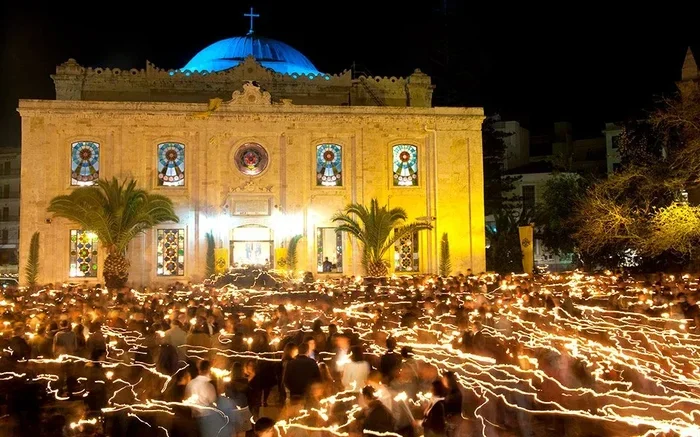
- Holy Saturday — The mood shifts. At midnight, churches hold the Resurrection service. At the stroke of midnight, the “Christ is risen” exchange begins. Candles are lit, and the Greek Orthodox Easter celebration truly starts.
- Easter Sunday — Families gather for a massive feast. The table features Easter lamb, roasted on a spit, along with wine, music, and dancing until dawn.
These Easter celebrations are deeply communal. They bring entire neighborhoods together. If you are in Greece during Holy Week, you will witness something truly unforgettable.
The Easter Feast: Food That Brings People Together
Greek Easter feasting is legendary. The meal on Easter Sunday is the culmination of weeks of preparation. Key dishes include:
- Arni o xorti — Roasted lamb on a spit, often prepared outdoors by the whole family.
- Magiritsa — A traditional soup made from lamb offal and herbs, eaten after the midnight service on Saturday.
- Red Easter eggs — Dyed deep crimson, these are both a tradition and a game piece for tsougrisma.
- Lambropsomo — A sweet, egg-rich bread shaped into braids or crosses.
- Koulourakia — Butter cookies shaped into twists, often given as Easter gifts.
Food is love in Greek culture. Sharing the Easter meal is how families express joy, gratitude, and togetherness.
How to Use These Greetings in Everyday Life
Now that you know the key phrases, let us talk about how to actually use them. Context matters. A greeting that works in church might feel too formal for a group chat. Here is your practical guide.
Face-to-Face Conversations
When you meet a Greek friend or neighbor during Easter, start with Καλό Πάσχα. If the occasion is religious—perhaps you are attending a service—use Χριστός ἀνέστη and be ready to respond with Ἀληθῶς ἀνέστη. Greeks will light up when you use these phrases. It shows genuine interest in their culture.
Texting and Social Media
Sending a digital Easter message is a wonderful idea. Text Καλό Πάσχα to your Greek friends on Easter morning. You can add emojis like 🐣🌺 or 🕯️ to make it feel warm and personal.
If you are texting in English, write something like: “Happy Easter from Greece! Καλό Πάσχα!” That bilingual approach feels natural and thoughtful. When you are part of fast-moving group chats during the holidays, you might come across various abbreviations and slang terms. For instance, if you see someone type “Wtw” and want to understand what they mean, you can learn the Wtw meaning in text to keep up with the conversation. Similarly, you might encounter short forms like “Ts” in Easter group chats—to decode that, you can check out the Ts meaning in text guide for quick clarity.
Adding a Greek Easter wish to your social media posts is also a great touch. It shows your followers that you appreciate Greek Easter customs and are part of the celebration, even from afar.
Written Cards and Letters
A handwritten card with Καλό Πάσχα or Ευτυχισμένο Πάσχα is a lovely gesture. It stands out in a world of generic messages. Take the time to write a few kind words in Greek. Your effort will be deeply appreciated.
Common Mistakes When Saying Happy Easter in Greek
Even with the best intentions, learners make mistakes. Here are the most common pitfalls to avoid when saying happy easter in greek:
- Mispronouncing the Greek letters. Greek letters do not always match English sounds. The “Χ” is not a “K” or “H”—it is a breathy “Kh.” The “ΣΧ” is not “S” plus “Ch.” Take time to learn the alphabet basics.
- Using the wrong greeting at the wrong time. Do not say Χριστός ἀνέστη casually to a coworker on Easter Monday. Reserve it for appropriate, respectful contexts. Καλό Πάσχα is your everyday workhorse.
- Ignoring the response. If someone says Χριστός ἀνέστη to you, do not just smile and move on. Always respond with Ἀληθῶς ἀνέστη. Leaving the exchange incomplete feels awkward and shows a lack of familiarity with the tradition.
- Overcomplicating things. You do not need to be fluent to greet someone. A simple, well-pronounced Καλό Πάσχα goes a long way. Keep it simple and sincere.
- Forgetting the cultural weight. Easter in Greece is not a casual party. It is a deeply spiritual event. Approach your Easter greetings with sincerity and respect, especially in religious settings.
Quick Tips for Avoiding Mistakes
- Practice pronunciation with a native speaker or a language app before your trip.
- Write down the phrases and keep them on your phone for easy reference.
- When in doubt, ask a Greek friend to help you practice. Most people will be happy to coach you.
- Listen to Greek Easter songs or watch videos of Greek Orthodox Easter services to hear natural pronunciation.
Expert Insights: What Greek Natives Want You to Know
We asked several Greek natives what they love (and do not love) about foreigners attempting Greek Easter greetings. Here is what they shared:
- “Even a rough attempt makes us so happy.” Greeks deeply value the effort. You do not need perfect grammar. Just trying to say Καλό Πάσχα correctly earns you major points.
- “Don’t skip the religious greeting if you are in church.” Using Χριστός ἀνέστη in a church setting is a beautiful sign of respect. It connects you to the community in a meaningful way.
- “Ask us to teach you.” Greeks love sharing their culture. If you are unsure about pronunciation or context, ask. It opens doors to real connection.
Conclusion: Speak, Celebrate, and Connect
Now you know how to say happy easter in greek like a native. You have the standard greeting, the traditional religious exchange, and a full understanding of the traditions that make Greek Easter so special. From tsougrisma to Holy Week rituals, from Easter lamb to midnight candlelight, you see the full picture.
The most important thing is to try. Speak the words. Share the greetings. Show up with curiosity and respect. That is what connects people across languages and cultures. A simple Καλό Πάσχα can brighten someone’s entire Easter. So go ahead, say it loud, say it proud, and enjoy the celebration.
Frequently Asked Questions
What is the most common way to say happy easter in greek?
The most common greeting is Καλό Πάσχα (Kalo Pascha), which means “Happy Easter.” It works in almost any setting, from casual conversations to formal events. It is the first phrase most learners and visitors use, and Greeks warmly respond to it regardless of your accent or fluency level.
What does “Christ is risen” mean in Greek, and when should I use it?
“Christ is risen” in Greek is Χριστός ἀνέστη (Christos Anesti). It is the traditional religious greeting used during Greek Orthodox Easter, especially during the midnight Resurrection service and in church. You should use it in religious or formal settings. The proper response is Ἀληθῶς ἀνέστη (Alithos Anesti), meaning “Truly, He is risen.”
How do I pronounce “Καλό Πάσχα” correctly?
Break it into two parts. Καλό is pronounced “Kah-loh” with a hard “K” and stress on the last syllable. Πάσχα is pronounced “Pah-skhah” where the “ΣΧ” makes a “skh” sound, similar to the “skh” in “sky.” Practice slowly at first, then build speed. Listening to native speakers on YouTube is one of the best ways to improve your pronunciation quickly.
Are there different Easter greetings for formal versus informal situations?
Yes. For everyday use, Καλό Πάσχα is perfect for any situation. For formal or religious contexts, use Χριστός ἀνέστη or Καλή Ανάσταση. For close friends and family, you can say Καλό Πάσχα, αγάπη μου (Happy Easter, my love). The key is matching your greeting to the setting and your relationship with the person.
What are some important Greek Easter traditions I should know about?
Key traditions include tsougrisma (the Easter egg cracking game), Holy Week services leading up to Easter Sunday, the midnight Resurrection ceremony, and the grand Easter feast featuring roasted lamb and Easter bread. Red-dyed eggs are central to the celebration, symbolizing the blood of Christ and eternal life. These Easter celebrations bring families and communities together in a deeply meaningful way.
Can I send a Greek Easter greeting in a text message or on social media?
Absolutely. Sending Καλό Πάσχα via text or social media is a thoughtful gesture. You can add emojis like 🐣🌺🕯️ to make it feel warm. If you want a more formal digital message, try Ευτυχισμένο Πάσχα (Blessed Easter). Combining English and Greek in your post shows appreciation for Greek Easter customs and makes your message stand out from generic holiday wishes.



