
Knowing how to say what time is it in French is a must-have skill for travelers and language learners alike. This guide covers everything from basic French time-telling phrases to tricky expressions like “et quart” and “et demie.” You will learn how to ask the time, read a clock in French, and avoid common errors that trip up beginners.
Key Takeaways
- Ask the time in French using “Quelle heure est-il?” or the casual “Il est quelle heure?”
- Master French numbers 1-12 to tell hours confidently in any conversation.
- Learn key phrases like “et quart,” “et demie,” and “moins le quart” for precise time-telling.
- Understand AM and PM equivalents in French: “du matin,” “de l’après-midi,” and “du soir.”
- Avoid common mistakes like using English-style time-telling patterns that sound unnatural in French.
- Practice with real examples and quick tips to build confidence fast.
📑 Table of Contents
- How to Say What Time Is It in French the Easy Way
- The Basic French Phrase for Asking the Time
- How to Answer: Telling the Time in French
- Special French Time Expressions You Need to Know
- AM and PM in French: Morning, Afternoon, and Evening
- Common Mistakes When Telling Time in French
- Practical Examples and Real-Life Scenarios
- Comparing French and English Time-Telling
- Expert Insights: Tips from French Speakers
- How to Practice Telling Time in French Every Day
- Conclusion
How to Say What Time Is It in French the Easy Way
Have you ever found yourself in a French-speaking country, completely lost on what time it is? Maybe you missed a train or showed up late to a café meeting. It happens to the best of us. Learning how to say what time is it in French is one of the most practical skills you can pick up. It opens doors in real-life situations and makes conversations flow naturally.
The good news? Telling time in French is simpler than you think. Once you grasp a few core phrases and number patterns, you will be asking and answering time-related questions with confidence. This guide walks you through every step. We cover basic questions, common expressions, and even some fun tips that native speakers use. Let us dive in.
Why Telling Time in French Matters
Time is a part of daily life everywhere. In France, punctuality matters, especially for meetings, appointments, and social gatherings. If you do not know how to say what time is it in French, you may struggle with basic tasks. You might miss a bus, arrive late to a dinner reservation, or misunderstand a schedule.
Beyond practicality, knowing how to tell time shows respect for the language and culture. When you make the effort to speak even simple French phrases, people notice. It builds trust and opens up warmer interactions. Plus, it is a great confidence booster for beginners. Every small win counts.
Quick Tip
Start by memorizing just five French phrases related to time. You will be surprised how far that gets you in everyday conversations. French names and phrases can be fun to explore once you build a basic foundation.
The Basic French Phrase for Asking the Time
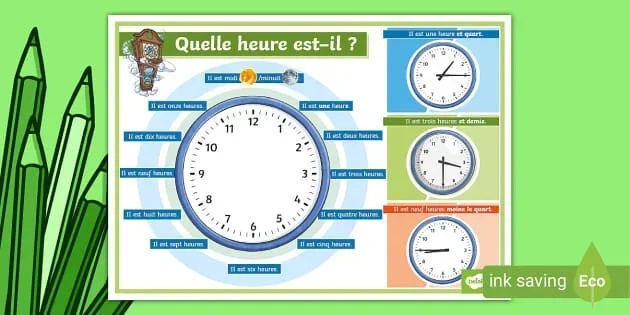
The most direct way to ask the time in French is “Quelle heure est-il?” This translates to “What hour is it?” It is the standard and polite way to ask. You will use this in almost every situation, from formal settings to casual chats.
There is also a shorter, more casual version. You can say “Il est quelle heure?” This flips the sentence structure slightly. Both versions mean the same thing. The first one sounds a bit more polished. The second one feels more relaxed and is common in everyday speech.
Here are a few ways to ask the time in French:
- Quelle heure est-il ? — What time is it? (formal)
- Il est quelle heure ? — What time is it? (casual)
- Tu as l’heure ? — Do you have the time? (informal)
- Vous avez l’heure ? — Do you have the time? (polite/formal)
Notice the difference between “tu” and “vous.” “Tu” is for friends and family. “Vous” is for strangers, elders, or professional settings. Using the right form of address shows cultural awareness. It is a small detail that makes a big difference.
Quick Tip
If you are ever unsure whether to use “tu” or “vous,” default to “vous.” French speakers appreciate politeness, especially from learners. It shows good manners and respect.
How to Answer: Telling the Time in French
Once you know how to ask, you need to know how to answer. The basic structure is simple: “Il est [hour].” This means “It is [hour].” Let us break it down step by step.
First, you need to know the French numbers for hours. Here they are:
- 1 — une heure
- 2 — deux heures
- 3 — trois heures
- 4 — quatre heures
- 5 — cinq heures
- 6 — six heures
- 7 — sept heures
- 8 — huit heures
- 9 — neuf heures
- 10 — dix heures
- 11 — onze heures
- 12 — douze heures
Notice that “heure” changes to “heures” for all numbers except one. This is one of the first things beginners get wrong. Always remember: “Il est une heure” for 1 o’clock, and “Il est [number] heures” for everything else.
Now, let us add minutes. In French, you use simple addition after the hour. For example:
- Il est deux heures dix. — It is 2:10.
- Il est cinq heures vingt-cinq. — It is 5:25.
- Il est neuf heures quarante. — It is 9:40.
The pattern is straightforward. State the hour, then add the minutes. No fancy grammar needed. Just clear and simple French time-telling.
Common Mistake
Many English speakers try to say “It is two ten” by translating directly. In French, you say “Il est deux heures dix,” not “Il est deux dix.” Always include “heures” after the hour number. Skipping it sounds incomplete and unnatural.
Special French Time Expressions You Need to Know
French has some unique ways of expressing time that go beyond simple addition. These expressions are everywhere in daily conversation. If you do not know them, you will miss a lot of meaning. Let us look at the most important ones.
Quarter and Half Hour Expressions
In English, we say “quarter past” or “half past.” French uses similar but slightly different phrasing:
- Et quart — and a quarter (meaning 15 minutes past the hour)
- Et demie — and a half (meaning 30 minutes past the hour)
- Moins le quart — minus a quarter (meaning 15 minutes to the next hour)
Here is how they work in full sentences:
- Il est trois heures et quart. — It is 3:15.
- Il est sept heures et demie. — It is 7:30.
- Il est dix heures moins le quart. — It is 9:45.
One important rule: “et demie” always refers to the exact half-hour mark. And “moins le quart” always refers to 15 minutes before the next hour. These patterns are consistent and easy to remember once you practice them a few times.
Quick Tip
Think of “moins le quart” as “a quarter to” in English. The word “moins” means “minus” or “less.” So “dix heures moins le quart” literally means “ten hours minus a quarter,” which equals 9:45.
AM and PM in French: Morning, Afternoon, and Evening
English uses AM and PM to distinguish between morning and afternoon. French does not work the same way. Instead, French speakers use time-of-day expressions to clarify the context:
- Du matin — in the morning (roughly midnight to noon)
- De l’après-midi — in the afternoon (roughly noon to 6 PM)
- Du soir — in the evening (roughly 6 PM to midnight)
You can add these to your time sentences for extra clarity:
- Il est huit heures du matin. — It is 8:00 AM.
- Il est deux heures de l’après-midi. — It is 2:00 PM.
- Il est neuf heures du soir. — It is 9:00 PM.
In most casual conversations, French speakers rely on context. If someone says “Il est deux heures,” you can usually figure out whether it is morning or afternoon from the situation. But adding “du matin,” “de l’après-midi,” or “du soir” removes all doubt. It is a good habit to build early.
Quick Tip
In 24-hour format, which is very common in France, you simply say the number. “Il est quatorze heures” means 2:00 PM. Many train schedules and official documents use this format. Learning to recognize 24-hour time will help you navigate France with ease.
Common Mistakes When Telling Time in French
Even motivated learners make mistakes with French time-telling. Here are the most common ones to avoid:
Skipping “Heures” After the Hour
This is the number one mistake. Saying “Il est deux dix” instead of “Il est deux heures dix” sounds incomplete. Always include “heures” after the hour number.
Confusing “Et Demie” and “Moins le Quart”
Beginners sometimes mix up these expressions. Remember: “et demie” means 30 minutes past the hour, and “moins le quart” means 15 minutes before the next hour. A quick way to remember: “demie” sounds like “half,” and a half hour is 30 minutes.
Using English Word Order
In English, we might say “It is ten to eleven.” In French, you would say “Il est onze heures moins dix.” The hour comes first, then the minutes. The structure is different from English, so try to think in French patterns rather than translating directly.
Quick Tip
One helpful trick is to practice saying the time out loud every day. Pick a random time, look at a clock, and say it in French. Repetition builds muscle memory and makes the phrases feel natural over time.
Practical Examples and Real-Life Scenarios
The best way to learn how to say what time is it in French is through practice. Let us look at some real-life situations you might encounter.
At a Train Station
You approach a ticket counter and want to confirm a departure time. You might ask:
- “À quelle heure part le train ?” — What time does the train leave?
- The agent replies: “Il est quatorze heures trente.” — It is 2:30 PM.
Meeting a Friend for Coffee
You text a friend to confirm plans. In casual French texting, you might write:
- “On se voit à quelle heure ?” — What time are we meeting?
- Your friend replies: “On se voit à sept heures et demie.” — We meet at 7:30.
If you are texting about the time, you might also come across informal abbreviations. Understanding texting shorthand in French can be helpful here. If you want to explore more about French text abbreviations, check out resources on WTW meaning in text and other common shorthand terms used in digital communication.
At a Restaurant
The waiter asks when you would like to eat. You reply:
- “Je voudrais réserver pour sept heures moins le quart.” — I would like to reserve for 6:45.
These scenarios show how telling time in French comes alive in real situations. The more you practice, the more natural it becomes.
Quick Tip
Try setting your phone or watch to French language settings. Seeing the time displayed in French throughout the day is a passive but powerful way to reinforce your learning.
Comparing French and English Time-Telling
Understanding the differences between English and French time-telling helps you avoid confusion. Here is a quick comparison:
| English | French | Example |
|---|---|---|
| It is 3:00 | Il est trois heures | Il est trois heures |
| It is 3:15 | Il est trois heures et quart | Il est trois heures et quart |
| It is 3:30 | Il est trois heures et demie | Il est trois heures et demie |
| It is 3:45 | Il est quatre heures moins le quart | Il est quatre heures moins le quart |
| It is 3:20 | Il est trois heures vingt | Il est trois heures vingt |
This table shows the core patterns. Once you internalize these structures, you can handle almost any time-related question in French. The key is to practice until the patterns feel automatic.
Clock-related expressions vary across languages, and French is no exception. The way French speakers describe time reflects their cultural approach to punctuality and daily life. Embracing these differences enriches your language learning journey.
Expert Insights: Tips from French Speakers
Native French speakers share a few insider tips that textbooks often miss:
- Use “midi” for noon and “minuit” for midnight. These are the standard terms. “Il est midi” means it is noon. “Il est minuit” means it is midnight.
- In casual speech, “heures” is sometimes dropped. You might hear “Il est deux dix” in very relaxed conversation. But as a learner, always use the full form to sound clear and correct.
- French people often use the 24-hour clock. “Il est quatorze heures” is more common than “Il est deux heures de l’après-midi” in many settings.
- Listening to French podcasts or radio helps. Hearing the time spoken naturally trains your ear. You will start to pick up rhythm and pronunciation without effort.
These insights come from real experience. They help you sound more natural and feel more comfortable in French-speaking environments.
How to Practice Telling Time in French Every Day
Consistency is the secret to mastering any language skill. Here are simple ways to practice French time-telling daily:
- Set your devices to French. Phones, computers, and tablets can display the time in French. You will see the language constantly.
- Say the time out loud three times a day. Morning, afternoon, and evening. Just glance at a clock and state the time in French.
- Use flashcards with clock faces. Draw or print clock images and write the French time underneath. Quiz yourself regularly.
- Watch French videos with subtitles. You will hear time expressions in context and see them written at the same time.
- Find a language exchange partner. Practice asking and answering time questions with a native speaker or fellow learner.
These methods are simple but effective. You do not need expensive courses or fancy tools. Just a little daily effort goes a long way.
Remember that language learning is a journey. Every minute you spend practicing brings you closer to fluency. And knowing how to tell time is one of the first milestones you will hit. Celebrate that progress.
Also, exploring the broader French language landscape can be fun and educational. Learning about funny French names or cultural expressions adds color to your studies and keeps you motivated.
Conclusion
Learning how to say what time is it in French is a foundational skill that every French learner needs. From the basic question “Quelle heure est-il?” to special expressions like “et quart” and “moins le quart,” the patterns are logical and easy to grasp. With consistent practice, you will be telling time in French naturally and confidently.
Focus on the core phrases first. Build from there. Avoid the common mistakes we covered. And most importantly, practice every day. Even five minutes of repetition makes a real difference over time.
Now you have all the tools you need. Go ahead, put them into use, and start telling time in French like a native. Bonne chance!
Frequently Asked Questions
What is the most common way to ask the time in French?
The most common and polite way is “Quelle heure est-il?” This translates directly to “What hour is it?” It works in all settings, from formal to casual. For informal situations, you can also use “Tu as l’heure?” which means “Do you have the time?”
How do you say 7:45 in French?
You say “Il est huit heures moins le quart.” This literally means “It is eight hours minus a quarter.” French uses subtraction for times that are closer to the next hour, which is different from English where we say “quarter to eight.”
Do French people use AM and PM?
Not really. French speakers use time-of-day expressions instead. “Du matin” covers the morning, “de l’après-midi” covers the afternoon, and “du soir” covers the evening. Many also use the 24-hour clock format, especially for official schedules and train times.
Is the 24-hour clock common in France?
Yes, very common. The 24-hour format is standard in France for trains, schedules, and official documents. For example, 2:00 PM is expressed as “quatorze heures” in the 24-hour format. Learning this format will help you navigate daily life in French-speaking countries with ease.
What does “et demie” mean in French?
“Et demie” means “and a half,” referring to 30 minutes past the hour. For example, “Il est six heures et demie” means “It is 6:30.” The word “demie” comes from “demi,” meaning half, and it always follows the hour number.
How can I practice telling time in French every day?
Set your phone or watch to French, and simply glance at the time throughout the day. Say it out loud in French each time. You can also use flashcards with clock faces, watch French videos, or find a language exchange partner. Consistent daily practice, even just a few minutes, builds real fluency over time.