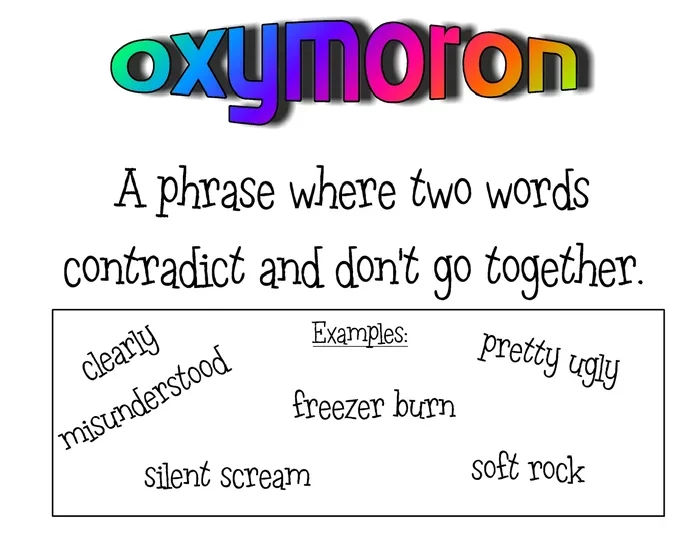

The oxymoron meaning is a figure of speech that combines two opposite or contradictory words to create a unique effect. Understanding oxymoron meaning helps you write better, speak more creatively, and appreciate literature on a deeper level. This guide breaks down the oxymoron meaning in plain English with real-world examples, practical tips, and expert insights.
Have you ever heard someone say “seriously funny” or “small crowd” and thought it sounded a little strange? That is because those phrases mix two opposite ideas together. This clever trick is called an oxymoron. And the oxymoron meaning is simpler than you might think.
In this guide, we will break down the oxymoron meaning in plain, easy-to-understand language. You will learn what it is, how it works, and why it matters in both writing and everyday talk. By the end, you will spot oxymoron examples everywhere around you.
Let us start with the basics. The oxymoron meaning comes from two Greek words. “Oxys” means sharp or keen. “Moron” means foolish. Put them together and you get something that sounds sharp but is actually a clever mix of opposites. In simple terms, an oxymoron is a figure of speech that joins two contradictory terms into one phrase. It is a type of literary device that writers and speakers use to make a point, create humor, or add depth to their words.
You do not need to be a poet or a scholar to understand the oxymoron meaning. In fact, you probably use oxymorons every single day without even realizing it. They are all around us in casual conversation, in books, in movies, and in song lyrics. Once you know the oxymoron meaning, you will start to see them everywhere.
Key Takeaways
- Oxymoron meaning explained: An oxymoron is a literary device that pairs two contradictory words together for effect.
- It is different from a paradox: A paradox is a contradiction in logic, while an oxymoron is a contradiction in words.
- You use oxymorons every day: Phrases like “deafening silence” and “act naturally” are all oxymorons.
- It is a powerful writing tool: Oxymorons add depth, humor, and emphasis to your writing.
- Literature uses them heavily: Shakespeare, modern authors, and songwriters all rely on oxymorons.
- Understanding it improves communication: Knowing oxymoron meaning helps you read between the lines and write with more impact.
📑 Table of Contents
- What Is the Oxymoron Meaning in Plain English?
- Oxymoron Meaning vs. Paradox: What Is the Difference?
- Common Oxymoron Examples You Use Every Day
- Oxymoron Meaning in Literature and Pop Culture
- How to Spot and Create Your Own Oxymorons
- Why Understanding Oxymoron Meaning Makes You a Better Communicator
- Oxymoron Meaning in Everyday Language: Why It Matters More Than You Think
What Is the Oxymoron Meaning in Plain English?
The oxymoron meaning is straightforward. It is a combination of two words that have opposite meanings. When you put them together, they create a special effect. This effect can be funny, thought-provoking, or emotionally powerful.
Think of it like mixing hot and cold water. On its own, each temperature is simple. But when you mix them, you get something in between — warm water. An oxymoron works the same way. It takes two opposing ideas and blends them into one phrase that carries its own unique meaning.
The oxymoron meaning is part of a bigger family of figurative language. Other members of this family include metaphors, similes, and hyperbole. But the oxymoron is special because it uses contradiction as its main tool. It says two things that should not go together — and somehow, they do.
Why Do People Use Oxymorons?
People use oxymorons for many reasons. Here are some of the most common ones:
- To add humor: A phrase like “only choice” makes you smile because it feels a little silly.
- To create emphasis: Saying “bittersweet” captures a feeling that just one word cannot fully describe.
- To make writing more vivid: Oxymorons paint pictures in the reader’s mind.
- To express complex feelings: Love and sadness at the same time is hard to put into words. An oxymoron can do it in just two words.
- To grab attention: A surprising mix of words stops the reader in their tracks.
Now that you know the oxymoron meaning in simple terms, let us look at how it compares to a similar concept.
Oxymoron Meaning vs. Paradox: What Is the Difference?
One of the biggest questions people ask about oxymoron meaning is how it differs from a paradox. These two terms often get mixed up, but they are quite different.
A paradox is a statement that seems to contradict itself but may actually be true. For example, “less is more” is a paradox. It sounds impossible, but it makes sense in many situations. A paradox challenges your thinking. It makes you question what you believe.
An oxymoron, on the other hand, is just a pair of contradictory words. It does not try to reveal a deep truth. It simply places two opposites side by side for effect. The oxymoron meaning is about word play, not about logic.
Here is a quick way to remember the difference:
- Oxymoron: Two opposite words put together. Example: “deafening silence.”
- Paradox: A statement that contradicts itself but may still be true. Example: “I know one thing: that I know nothing.”
The oxymoron meaning is simpler and more playful. The paradox meaning is deeper and more philosophical. Both are powerful literary devices, but they serve different purposes.
When Do Oxymorons and Paradoxes Overlap?
Sometimes the line between an oxymoron and a paradox can feel blurry. For instance, “jumbo shrimp” is clearly an oxymoron. But when someone says “I was lonely in a crowd,” that could be seen as both an oxymoron and a paradox. In everyday writing, the terms are often used loosely. But if you want to be precise, remember that an oxymoron is about words, and a paradox is about ideas.
Understanding this distinction makes the oxymoron meaning much clearer. It also helps you use both tools more effectively in your own writing.
Common Oxymoron Examples You Use Every Day
The best way to understand the oxymoron meaning is to see it in action. You will be surprised at how many oxymoron examples you already know and use.
Everyday Oxymorons in Conversation
Here are some oxymoron examples that pop up in daily life:
- Act naturally — How can you act if you are being natural?
- Deafening silence — Silence cannot be loud, yet this phrase feels powerful.
- Only choice — If it is the only one, it is not really a choice.
- Small crowd — A crowd is big by definition, so “small” contradicts it.
- Clearly confused — Clarity and confusion are opposites.
- Original copy — An original cannot be a copy.
- Friendly fire — Fire that is friendly sounds impossible.
- Living dead — You cannot be alive and dead at the same time.
These oxymoron examples show how the oxymoron meaning works in real life. Each phrase pairs two opposite ideas to create a new, interesting meaning.
Oxymorons in Literature and Poetry
Writers have used oxymorons for centuries. William Shakespeare was a master of this technique. In Romeo and Juliet, he wrote “loving hate” and “cold fire.” These oxymorons capture the confusing nature of love perfectly.
Here are some famous oxymoron examples from literature:
- “Parting is such sweet sorrow” — Shakespeare, Romeo and Juliet
- “I must be cruel only to be kind” — Shakespeare, Hamlet
- “This is hell, nor am I out of it” — John Milton, Paradise Lost
- “A little death with no emotion” — Alfred Lord Tennyson
Each of these examples uses the oxymoron meaning to express emotions and ideas that plain words cannot capture. The contradiction forces the reader to pause and think. That is the magic of the oxymoron.
Oxymoron Meaning in Literature and Pop Culture
The oxymoron meaning goes far beyond the classroom. It shows up in movies, songs, TV shows, and even advertising. Let us explore how oxymorons shape popular culture.
Oxymorons in Song Lyrics
Songwriters love oxymorons because they create emotional impact in just a few words. Here are some well-known examples:
- “Deafening silence” — used in many songs to describe an overwhelming absence of sound.
- “Sweet pain” — a phrase that captures the feeling of love and hurt at the same time.
- “Cruel kindness” — a reminder that sometimes help can feel harsh.
When you hear these phrases in a song, the oxymoron meaning hits you emotionally. The contradiction makes the feeling stronger.
Oxymorons in Movies and TV
Movie scripts are full of oxymorons. Characters use them to sound clever, funny, or dramatic. Here are a few examples:
- “Random order” — often used in comedy to highlight absurdity.
- “Open secret” — something everyone knows but nobody talks about openly.
- “Same difference” — a sarcastic way to say two things are alike.
The oxymoron meaning in pop culture helps writers deliver quick, memorable lines. It adds wit and personality to dialogue.
Oxymorons in Advertising and Branding
Brands use oxymorons to stand out. Think about phrases like “seriously funny” or “honest scam.” These oxymorons grab your attention and make you curious. The oxymoron meaning in marketing is all about creating a memorable impression.
When a brand pairs two opposite ideas, it challenges the reader to stop and pay attention. That is exactly what good advertising aims to do. The oxymoron meaning becomes a tool for creativity and persuasion.
How to Spot and Create Your Own Oxymorons
Now that you understand the oxymoron meaning, let us talk about how to spot them and even create your own. This is a fun exercise that can improve your writing skills.
How to Spot an Oxymoron
Spotting an oxymoron is easy once you know what to look for. Follow these simple steps:
- Read the phrase carefully. Look for two words placed next to each other.
- Check if the words have opposite meanings. For example, “hot” and “cold” are opposites.
- See if the phrase makes a new meaning. A true oxymoron creates a fresh idea from the contradiction.
Not every pair of opposite words is an oxymoron. “Big and small” is just a comparison. But “bittersweet” is an oxymoron because it combines the two words into one phrase with its own meaning. The oxymoron meaning depends on how the words work together.
Tips for Creating Your Own Oxymorons
Want to try writing your own oxymorons? Here are some tips:
- Start with a feeling or idea. Think about something complex, like nostalgia or excitement mixed with fear.
- Find two opposite words that describe it. For example, “joyful sadness” or “loud quiet.”
- Make sure the phrase sounds natural. A good oxymoron should flow smoothly, even though it is contradictory.
- Test it out loud. Read the phrase to yourself. Does it sound interesting? Does it make you think?
Creating your own oxymorons is a great way to practice the oxymoron meaning. It also makes your writing more colorful and engaging.
Quick Tips for Using Oxymorons in Writing
Here are some quick tips to keep in mind:
- Use oxymorons sparingly. Too many can make your writing feel confusing.
- Place them where you want to create emphasis or a pause.
- Use them in dialogue to add personality to characters.
- Try them in poetry to add layers of meaning.
- Avoid forcing an oxymoron. If it does not fit naturally, leave it out.
The oxymoron meaning works best when it feels natural and purposeful. It is not about being clever for the sake of being clever. It is about adding something real to your words.
Why Understanding Oxymoron Meaning Makes You a Better Communicator
You might be wondering why the oxymoron meaning matters so much. After all, it is just a fancy term for mixing opposite words. But understanding oxymorons can actually make you a stronger communicator in many areas of life.
It Improves Your Reading Comprehension
When you read a book or an article, you encounter oxymorons all the time. If you do not know the oxymoron meaning, you might miss the deeper message the author is trying to convey. Understanding this literary device helps you read between the lines and catch subtle meanings.
It Boosts Your Writing Skills
Good writers use a variety of language devices to keep their readers engaged. The oxymoron meaning gives you a powerful tool to add color, emotion, and surprise to your writing. Whether you are writing an essay, a blog post, or a creative story, oxymorons can elevate your work.
It Makes You More Persuasive
In speeches, presentations, and even everyday conversations, oxymorons can make your point more memorable. A well-placed oxymoron sticks in the listener’s mind. It creates a moment of surprise that makes your message more impactful.
It Deepens Your Appreciation of Art and Media
When you watch a movie, listen to a song, or read a poem, oxymorons are often at work. Understanding the oxymoron meaning lets you appreciate the craft behind the words. You start to notice how writers and artists use contradiction to express complex truths.
The oxymoron meaning is not just an academic concept. It is a practical skill that enhances your everyday communication. Once you know it, you cannot unsee it. And once you can spot oxymorons, you will appreciate the beauty of language in a whole new way.
Common Mistakes People Make With Oxymorons
Even though oxymorons are simple, people sometimes make mistakes with them. Here are a few to avoid:
- Confusing oxymorons with similes or metaphors: A simile compares two things using “like” or “as.” A metaphor says one thing is another. An oxymoron combines opposites. The oxymoron meaning is unique.
- Forcing an oxymoron where it does not fit: Not every sentence needs an oxymoron. Use them only when they add value.
- Using too many at once: A single oxymoron can be powerful. Three in a row can feel overwhelming.
- Thinking all contradictory phrases are oxymorons: “Big building” is not an oxymoron because “big” and “building” are not opposites. The oxymoron meaning requires true contradiction.
Avoiding these mistakes will help you use oxymorons more effectively. It will also sharpen your understanding of the oxymoron meaning as a whole.
Oxymoron Meaning in Everyday Language: Why It Matters More Than You Think
You might think the oxymoron meaning is just for English class or literature discussions. But the truth is, oxymorons are deeply woven into everyday language. They shape how we express emotions, describe situations, and connect with others.
Think about how often you say things like “same difference” or “pretty ugly.” These phrases have become so common that most people do not even think of them as oxymorons anymore. But they are. And they carry the oxymoron meaning of blending opposites to capture a feeling that neither word could express alone.
The reason oxymorons are so popular in everyday talk is that they solve a problem. Sometimes, one word is not enough to describe what we feel. “Happy” does not cover the feeling of being happy but also a little sad. “Bittersweet” does. That is the power of the oxymoron meaning in action.
In professional settings, oxymorons can make your communication more vivid. In casual settings, they add flavor and personality to your speech. In creative writing, they are a goldmine of expressive possibilities. The oxymoron meaning is truly one of the most versatile tools in the English language.
As you go through your day, try to notice the oxymorons around you. Listen to your friends, your favorite songs, and the books you read. You will be amazed at how often the oxymoron meaning shows up in the most unexpected places.
Understanding the oxymoron meaning is not just about learning a definition. It is about opening your eyes to the richness of language. It is about seeing how opposite ideas can come together to create something beautiful, funny, or deeply true.
So the next time someone says “act naturally” or “seriously funny,” you will smile. You will know the oxymoron meaning behind those words. And you will appreciate the cleverness of language just a little bit more.
The oxymoron meaning is a gift to anyone who loves words. It gives you permission to mix the unmixable, to pair the impossible, and to find meaning in contradiction. That is what makes language so exciting and so human.
Now that you have a clear understanding of the oxymoron meaning, you are ready to use it in your own writing and conversations. Go ahead and try it. Create your own oxymorons. Share them with friends. And watch how people react to the clever blend of opposites.
The world of figurative language is vast and full of surprises. The oxymoron meaning is just one door into that world. But it is a door that leads to creativity, expression, and a deeper love for the power of words.
Remember, language is not just about rules and definitions. It is about connection, emotion, and beauty. The oxymoron meaning reminds us of that truth every time we use one. And that is why it matters.
Frequently Asked Questions
What is the simple oxymoron meaning?
An oxymoron is a figure of speech that combines two opposite or contradictory words into one phrase. The oxymoron meaning comes from Greek words meaning “sharp” and “foolish.” It is a literary device used to create interesting effects in writing and speech.
Can you give me three oxymoron examples?
Sure! Here are three common oxymoron examples: “deafening silence,” “act naturally,” and “bittersweet.” Each phrase pairs two opposite ideas to create a unique meaning. These oxymorons are used in everyday conversation and writing.
How is oxymoron meaning different from a paradox?
The oxymoron meaning focuses on contradictory words, while a paradox is a statement that contradicts itself but may still be true. An oxymoron is a word-level contradiction. A paradox is an idea-level contradiction. Both are literary devices, but they work differently.
Why do writers use oxymorons in their work?
Writers use oxymorons to add depth, humor, and emotion to their writing. The oxymoron meaning allows them to express complex feelings in just a few words. It also creates a striking effect that grabs the reader’s attention and makes the writing more memorable.
Are oxymorons only used in literature?
No, the oxymoron meaning shows up everywhere. You will find oxymorons in everyday conversation, song lyrics, movie scripts, advertising, and even casual texting. They are a natural part of how people use language to express complex ideas in a creative way.
How can I start using oxymorons in my own writing?
Start by thinking of a feeling or idea that is hard to describe with one word. Then find two opposite words that capture it. Combine them into a phrase. For example, “joyful sadness” or “loud quiet.” Practice makes perfect, and soon the oxymoron meaning will feel natural in your writing.
=== CONCLUSION ===
The oxymoron meaning is a fascinating and practical concept that anyone can understand and enjoy. It is more than just a fancy term from English class. It is a tool that makes your language richer, your writing more vivid, and your communication more expressive.
From everyday phrases like “deafening silence” to famous lines in literature, the oxymoron meaning is all around us. It shows us that opposites really can attract. And when they come together in the right way, they create something powerful and memorable.
Now that you know the oxymoron meaning inside and out, you are equipped to spot these clever phrases in books, songs, and conversations. You can even create your own oxymorons to add flair to your writing. The more you practice, the more natural it becomes.
So go ahead and embrace the oxymoron meaning. Let it inspire your creativity. Let it sharpen your reading skills. And most importantly, let it remind you that language is full of surprises waiting to be discovered.